
new
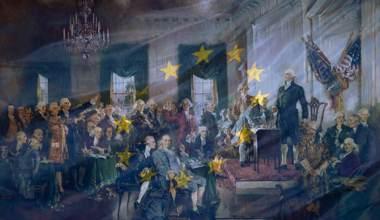
In September 1786, twelve delegates of five states met at a tavern in Annapolis, Maryland, to discuss how to fix the U.S. Constitution, the Articles of Confederation.
The main problem was that almost all executive, judicial and legislative power was wielded by the individual states, who used it to relentlessly pursue their own, ‘sovereign’ interests. Understandable — if shortsighted — since the United States technically was not even a country under the Articles of Confederation but a “firm league of friendship” of sovereign states.1
Under the Articles, each state could vote down almost all new legislation, Congress did not have the power to tax (it could only request money from the states, don’t need to be a political genius to figure out how well that went) and therefore did not have the money to maintain an army, it did not have the power to set collective tariffs — allowing the Europeans to play states off against each other — nor did it have the monopoly on currency minting, to name some of the Articles’ most pressing deficiencies.
Another key problem was that each state had to shoulder its own debt, a sizable sum in many cases on account of the Revolutionary War, which, though won, had also been very expensive (as wars tend to be). Some state governments enacted harsh fiscal policies, pushing their economies into depression territory and igniting social unrest. A notable example was Massachusetts, where a full-blown rebellion broke out in the summer of 1786, which was put down only months later.
The rub of it was that the Articles of Confederation had been drafted at the beginning of the revolution, at a time when the delegates of the Thirteen Colonies had been mostly concerned with gaining their independence from a strong, tyrannical government on the other side of the Atlantic. The last thing they wanted was to create a strong, tyrannical government on this side of the Atlantic.
So they forewent creating an executive power like a king or president, kept Congress weak and the individual states strong. A fine solution for nations wishing to remain small, insignificant and happy with what they have, but not for an ambitious young country wanting to prove itself and earn a seat at the big table.
That is what Alexander Hamilton must have thought when he and eleven other delegates met in Annapolis that summer of 1786. Not much was decided though, except to meet again next May in Philadelphia, “to devise such further provisions as shall appear to them necessary to render the constitution of the Federal Government adequate to the exigencies of the Union.”2 An important decision as it turned out, since the Philadelphia Convention would be one of the most paramount political gatherings in the history of the United States.
Hamilton was a Federalist. He wanted a strong federal government, with one common currency, a national debt, a single market and a common trade policy. Of course besides Federalists like Alexander Hamilton (later the first U.S. Secretary of Treasury), General George Washington, John Adams (the second U.S. President), James Madison (the fourth U.S. President) and John Jay (the first Chief Justice of the Supreme Court), there were also Anti-Federalists.
Such as Samuel Adams — the early revolutionary from Boston — James Monroe — the fifth U.S. President — and Patrick - Give me Liberty, or give me Death! - Henry. They were dead set against a strong central government, fearing it would trample on states’ rights just as Great Britain had done. Still, almost everyone agreed that the Articles of Confederation were not working and that something needed to be done.
How do you fix a building with an inherently weak foundation? By tearing it down and rebuilding it from the ground up.
In other words, by showing some balls.
That is exactly what the 55 delegates at the Philadelphia Convention did between May and September of 1787. Instead of trying to muddle through with the existing, flawed constitution, they debated and created an entirely new one, transferring executive, legal and judicial supremacy to the federal level, with a Congress that had the power to tax and legislate through majority rather than unanimity, an elected President invested with executive powers and a Supreme Court that would have the final say in judicial matters.
That is not to say any of these decisions were taken lightly or that the delegates agreed on everything, far from it. The final version of the constitution, to be sent to the Confederate Congress for approval, was, of course, a compromise. Nobody got exactly what they wanted, but as Benjamin Franklin summarized his own view — and likely that of most other delegates:
“There are several parts of this Constitution which I do not at present approve, but I am not sure I shall never approve them.”(…) “Thus I consent, Sir, to this Constitution because I expect no better, and because I am not sure, that it is not the best. The opinions I have had of its errors, I sacrifice to the public good.”3
A potentially major obstacle to ratification of the new constitution was that under the rules of the Articles of Confederation, all states needed to give their consent. An impossible requirement, given that the states had not even been able to agree on granting the federal government the right to collect customs duties (a bill to this effect was vetoed by Rhode Island in 1782), let alone on an entirely new constitution that transferred much of their own powers to the federal government.
Boldly sidestepping this constitutional stranglehold, the Philadelphia delegates therefore decided that the consent of nine out of thirteen states would be enough to ratify the new constitution. (interestingly, when several Southern States decided to leave the Union and form the Confederate States of America, fourscore minus six years later — an act comparable to the decision of the Philadelphia delegates to ignore the required unanimity of the Articles — it was considered traitorous by the other states.)
Brilliantly defending the Convention’s choice to supersede the Articles’ strictures like this, James Madison wrote: "that in all great changes of established governments, forms ought to give way to substance; that a rigid adherence in such cases to the former, would render nominal and nugatory the transcendent and precious right of the people to “abolish or alter their governments as to them shall seem most likely to effect their safety and happiness”".4
The Convention also asked the Confederate Congress not to debate the constitution point by point but instead send it to the state legislatures unaltered and ask them to put it to popular vote. This was another smart move, as the Confederate Congress — not to mention the states legislatures — would no doubt have watered down the constitution to the kind of ugly legal beast that can only be killed by driving a wooden stick through its legal heart (if by then it still had one).
Which brings me to the European Union, another firm league of friendship seemingly far removed from any unity at the moment. Both on paper and in reality, European integration has progressed tremendously in the past 50 years. But unlike at the beginning of the Great European Project, there is no longer any passion, zeal or vision. When it comes to the EU, European leaders — not to mention its citizens — act like 20somethings who knocked up their girlfriend and now feel they can’t get out of the relationship, even though the more they think of the life ahead the more they want to.
The EU has its own parliament, single market, shared currency, central bank and secretary of state.5 But what it does not have is a shared economic policy, fiscal policy, budgetary policy, immigration policy or foreign policy. It is not hard to see why this is a recipe for failure. 21st century Europe — like late 18th century U.S. under the Articles of Confederation — is simply not working.
And if the Global Financial Crisis of 2008, the Sovereign Debt Crisis, the Greek Crisis, the global threat of Islamic terrorism, the resurgent Cold War and the massive immigrant influx from Africa and the Middle East to Europe have made one thing clear it is this: Muddling through — as Europe has done for the past few decades — is no longer an option.
It is time for European leaders to start showing some balls, tear down the weak foundation of the European Union and rebuild a United Europe.
1 Article III of The Articles of Confederation and Perpetual Union: "The said States hereby severally enter into a firm league of friendship with each other, for their common defense, the security of their liberties, and their mutual and general welfare, binding themselves to assist each other, against all force offered to, or attacks made upon them, or any of them, on account of religion, sovereignty, trade, or any other pretense whatever.”
2 “Proceedings of Commissioners to Remedy Defects of the Federal Government: 1786.” Avalon Project, Yale Law. n.p. n.d. Web. June 2, 2015
3 Qtd. in The Debates on the Adoption of the Federal Constitution in the Convention held at Philadelphia in 1787, with a Diary of the Debates of the Congress of the Confederation as reported by James Madison, revised and newly arranged by Jonathan Elliot. Complete in One Volume. Vol. V. Supplement to Elliot’s Debates. Jonathan Elliot, ed. Philadelphia. 1836. (617-618).
4 The Federalist No. 40. On the Powers of the Convention to Form a Mixed Government Examined and Sustained. James Madison. New York Packet. January 18, 1788. The quote Madison uses is from the Declaration of Independence
5 The euro is not shared by the entire European Union, only by 19 of the 28 member states. For the purpose of this article, when I talk about the EU, I make no distinction between EU and the Eurozone.

On October 31, 1786, George Washington wrote a letter to one Henry Lee in defense of a stronger federal government. The letter contained an excellent quote for my book, showing how momentum was building up for replacing the Articles of Confederation - the first U.S. Constitution - with the current U.S. Constitution.
I should have left it at that.
And I almost did, but just before I moved on - it really couldn’t have been more than half a second before - my eyes were drawn to the name ‘Lee’.
Now, not being from Virginia, I only know one person whose last name is Lee, and that is Robert E. Lee, general and commander of the Army of Northern Virginia during the Civil War. Glimpsing that common, yet famous three-letter name, I just wondered if the Henry Lee of the letter was related to him in some way.
Of course to anyone from Virginia this is a ridiculous question, because A) there are many Lees in Virginia and B) they are all related to each other in some way.
Still, I had an inkling something interesting was lurking in the past.
So I googled ‘Henry Lee’ and clicked the top search result (disregarding Dr. Henry Chang-Yu Lee), a wikipedia page about Henry Lee III. Sure enough, Henry Lee III, also known by the pretty awesome nickname “Light-Horse Harry”, had served as a cavalry officer under General Washington during the American Revolution. His mother, Lucy Grymes Lee, had apparently been courted by George Washington before marrying Light-Horse Harry’s father, Henry Lee II (whose father, as you might have guessed, was Henry Lee I).
What was more, Light-Horse Harry was indeed related to Robert E. Lee, and not as some distant third cousin twice removed either. He was his father.
Other sources confirmed the information about Henry Lee III, but the most important question had not been answered yet. Was Henry Lee III also the Henry Lee that Washington had written this particular letter to?
At first it seemed almost impossible that he wasn’t, but then I stumbled onto Richard Henry Lee.
An Anti-Federalist, Richard Henry Lee had been President of the Continental Congress between 1784-1785. He had also been a delegate to both the First and Second Continental Congress and was the one who had put forth the motion calling for independence on June 7, 1776.
There was also a relation between Richard Henry Lee and Robert E. Lee, because Richard Henry Lee’s daughter Anne had been married to Charles Lee, brother of Henry Lee III, father of the famous Civil War general.
At the time Washington wrote the letter, Richard Henry Lee was certainly a more important political figure than Light-Horse Harry, but of course that didn’t necessarily mean he was the Lee I was looking for.
So I checked the National Archives to get a quick view of the recipients of Washington’s letters (founders.archives.gov). Initially, this only complicated my by-now-even-to-me-ludicrous-quest though. Yes, Washington had written to Richard Henry Lee, but he had also written to Henry Lee, Henry Lee Jr., and a whole bunch of other Lees (Charles Lee, Thomas Sim Lee, Arthur Lee, Ludwell Lee, Sidney Lee, Edmund Jennings Lee, Francis Lightfoot Lee, Philip Richard Francis Lee, Richard Bland Lee….).
My original source had the letter addressed to ‘Henry Lee’, but according to the National Archives the letter of October 31, 1786, was addressed to Henry Lee, Jr., not Richard Henry Lee, though the latter was also listed as a recipient of letters from Washington.1 In other words, according to the National Archives, the recipient of Washington’s October 31 letter was definitely not Richard Henry Lee. I was still not sure that Henry Lee Jr. was the same as Henry “Light-Horse Harry” Lee III, but evidence was mounting that he was.
For instance, at the end of another letter to Henry Lee, Jr., on June 18, 1786, Washington thanks him in advance “for your care of the inclosed.” That ‘inclosed’ was another letter, written to David Humphreys on June 20. In it, Washington writes that he will ask “Colo. Lee” to deliver it. Henry Lee III was a Lieutenant Colonel at the time.
A final piece of evidence came from the October 31 letter itself, in which Washington writes, towards the end: “The China came to hand without much damage; and I thank you for your attention in procuring & forwarding of it to me.” Another source (mountvernon.org) mentions that Washington had given Henry Lee Jr. money to purchase a set of blue Fitzhugh bordered china.2 The same source also mentions that Henry Lee, Jr. was promoted to Lieutenant Colonel by general Washington in 1780.
So, the Henry Lee that George Washington had written a letter to calling for a stronger federal government — less than a year before the Constitutional Convention of 1787 — had indeed been Henry Lee III, the father of Robert E. Lee, the general who would almost succeed in breaking up the union.
And another footnote had earned its place in the history books a history book.
1 “From George Washington to Henry Lee, Jr., 31 October 1786,” Founders Online, National Archives (http://founders.archives.gov/documents/Washington/04-04-02-0286 [last update: 2015-03-20]). Source: The Papers of George Washington, Confederation Series, vol. 4, 2 April 1786 – 31 January 1787, ed. W. W. Abbot. Charlottesville: University Press of Virginia, 1995, pp. 318–320.
2 "Henry Lee, Jr." n.p. n.d. George Washington’s Mount Vernon. mountvernon.org. Web. June 4, 2015.

Many European citizens may still cherish the idea of being from Germany, France, Spain, Italy or the Netherlands, but in reality Europe is already a country, they just don’t know it yet.1
In particular the nineteen countries that share the euro are far less sovereign than their citizens are led to believe. Because apart from the European Parliament, the European Commission and the European Court of Justice, these nineteen countries also share a central bank, a common monetary policy and - as recent history has shown - a common responsibility for each other’s debt obligations in all but name.
Politically, the current Eurozone much resembles the United States in the first decade of its existence, when it was governed by the hopelessly inadequate Articles of Confederation. Of course the idea behind the Articles was very understandable. The Thirteen Colonies had just revolted against their colonial overlord and were naturally wary of simply handing over power to yet another overlord, even if it called itself by another name and spoke with a more familiar accent.
But however natural, sympathetic and understandable, the Articles of Confederation and the “firm league of friendship” it aimed to establish simply did not work. The newborn United States was politically inefficient, economically fragile and vulnerable to outside interference. It all seems eerily similar to that firm league of friendship on the other side of the big pond, doesn’t it?
So far the Eurozone isn’t paying heed to the history lesson about the early United States though, preferring instead to keep playing country, like soldiers who refuse to unite against a charging enemy because they are in different foxholes. European politicians would do better to stop pretending for the sake of election rhetoric though, and instead start explaining why a United States of Europe is not only inevitable but also necessary.
Below are nine steps to get there.
1. One elected President. Europeans are always complaining that everything is decided in Brussels. If that is true (and in many ways it is), the people should have a bigger say in the European government. The currently powerless EU President should therefore be elected directly by the people and vested with all the powers of the office of the President of the European Commission.
2. One government bond. Part of the reason why the European sovereign debt crisis almost brought Europe to its knees and stifled economic growth, is because while there was no shared debt it quickly became clear member states would still be at risk when one of them defaulted on his debt. This risk could be negated through the introduction of European bonds, provided it goes hand in hand with a shared budgetary and fiscal policy.
3. One budgetary policy. The federal European government and the European Parliament should be responsible for budgetary policy and should sign off on the national budgets proposed by each Eurozone member state. The federal European government has the power to fine individual member states if they exceed their federally approved budgets.
4. One fiscal policy. The European government and parliament should be responsible for the fiscal policy of the Eurozone. It makes no sense to have a shared internal market and a shared monetary policy (by way of the ECB) but local fiscal policies that do not work in concert to improve unemployment rates and stabilize business cycles throughout the Eurozone.
5. One European second language. Aside from their national language, Europeans must be able to communicate in one common language if they are to truly benefit from the internal market. This common language must be English, because it’s easier to learn and far more universally spoken than Spanish, French, German or Italian (it is true that Spanish and French are spoken in many countries, but English is the de facto second language in the world).
6. One European Constitution. The abandoned ‘Treaty establishing a Constitution for Europe’ should be revived. Among other things, the European Constitution enshrines common values and aims of the member states and simplifies the decision making process within the EU’s institutions. It could also contribute to a feeling of unity in Europe.
7. One military. There is no point in every member state maintaining its own army, navy and air force. Potential threats are not coming from other member states and if a member state is attacked, article 5 of NATO already demands the other member states’ assistance, since all Eurozone member states are also members of NATO.
8. One foreign policy. This relates to several of the earlier points. It is counter-productive for member states to formulate individual foreign policies, since their foreign policy interests are similar for the most part. Some forty years ago, then U.S. Secretary of State Henry Kissinger asked who he should call if he wanted to talk to Europe.2 It is time to answer this question more decisively than with a High Representative of the Union for Foreign Affairs and Security Policy, whose role and powers are still very vague.
9. One capital. Currently, the European Parliament moves from Brussels to Strasbourg about once a month, as part of some silly agreement aimed at needlessly pleasing the French. This monthly moving circus costs the European taxpayer some €150 million per year.3 It is time to take the European electorate more seriously and put an end to this kind of topographical cronyism. The capital of Europe is Brussels, not Strasbourg.
1 For the sake of argument, when I talk about ‘Europe’ in this post I mean the Eurozone and not the European Union as a whole.
2 In an interview in 2012, Kissinger said about this famous statement: “I am not sure I actually said it. But it’s a good statement so why not take credit for it?” (Gera, Vanessa. “Kissinger says calling Europe quote not likely his.” bigstory.ap.org)
3 Mendick, Robert. “The farce of the EU traveling circus.” telegraph.co.uk.
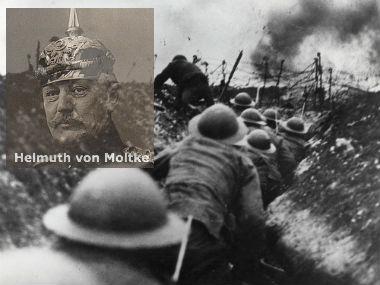
After the German army had begun its retreat to the Aisne River on September 9, 1914 (following its defeat at the first Battle of the Marne), Helmuth von Moltke, the German Chief of Staff, told Emperor Wilhelm II: „Majestät, wir haben den Krieg verloren!" (Your Majesty, we have lost the war!)1
The goal of the German war plan had been to deploy the vast majority of the army in France first, to deliver a fast, decisive victory there, before moving most of the troops to the Eastern front to deal with the Russian Empire. But now that there was not going to be a decisive victory in France, the German Empire would in all likelihood face a prolonged two-front war it could not win.
No one knew this better than Moltke himself, since he had been responsible for the German war plan of 1914. Although history books often still call it the Schlieffen Plan, the reality is that Moltke had already succeeded Count Schlieffen as Chief of the Imperial General Staff eight years earlier, in 1906, and had not implemented the latter’s final war plans without making some key alterations. But Moltke had indeed taken much of his inspiration from the two deployment plans Schliefen had devised just before his retirement, called Westaufmarsch (a.ka. Aufmarsch I) and Ostaufmarsch (a.k.a Aufmarsch II).2
Aufmarsch I was based on an isolated war between Germany and France, with a numerical superior Germany army outflanking the French forces by marching through the southern Netherlands, Belgium and Luxemburg, to counter-attack what Schlieffen believed would be a French attack on the French-German border in Lorraine.3 Aufmarsch II was based on a two-front war with Russia and France and diverted more divisions to East Prussia, to defend against a Russian attack before mounting a counter-attack.4
Moltke based his own operational plan on Aufmarsch II, but used the overall strategy of Aufmarsch I, meaning the wheel-like motion of the right wing to attack the French forces - who would presumably be engaged in Lorraine - in the flank and rear. There were however two fundamental differences between Schlieffen’s plan(s) and Moltke’s.
The first was that Schlieffen did not factor in war with Russia in Aufmarsch I (his deployment plan for war with France) and thus positioned only a few divisions in East Prussia, using the rest on the Western front. Considering the fact that in 1905 the Russian Empire was mired in revolution and war with Japan, this was not an altogether unreasonable presumption. Secondly, Schlieffen used more divisions in his plan than had actually been at his disposal. In his 1905 attack plan for war with France for instance, Schlieffen deployed ninety-two divisions, twenty more than actually existed.5
In other words, Moltke based the overall strategy for the Western part of his two-front war plan on a one-front war plan in which twenty extra, non-existent divisions (two entire armies) had been added to the equation. One could therefore argue that in the eyes of Count Schlieffen at least, Moltke’s attack plan was doomed to fail from the start, simply because it lacked the necessary military strength.6
During the first weeks of the war, when it became clear that Russia was mobilizing much faster than had been anticipated, Moltke sent three more corps and a cavalry division to the East, further weakening the right wing on the Western front.
As it turned out, those troops were still in transit when General von Hindenburg's Eighth Army delivered a crushing defeat to the Russians at the Battle of Tannenberg, between 26-30 August 1914. They were dearly missed at the Western front though, where the Germans came very close to breaking the French lines at the First Battle of the Marne (5-12 September 1914) but were ultimately defeated by a last ditch effort from the French, who threw everything they had in the fight, including 1,200 Parisian taxicabs that had been commandeered to transport 6,000 French reserves to the battlefield.
Did Moltke really believe Germany had already lost the war in September 1914? Perhaps. In any case he was relieved of his position and succeeded by Erich von Falkenhayn on 14 September 1914 (just two days after the conclusion of the First Battle of the Marne) and therefore no longer in a position to act upon it.
Moltke died on June 18, 1916, with casualties of the Battle of Verdun already in the hundreds of thousands and the even bloodier Battle of the Somme about to begin.
1 Der Erste Weltkrieg. Otto Ernst Schüddekopf. p. 18. Bertelsmann Lexikon-Verlag. 1977.
2 Inventing the Schlieffen Plan: German War Planning 1871 - 1914. pp. 32 - 33. Terence Zuber. Oxford: Oxford University Press. 2002. ISBN 0199250162.
3 Ibid
4 Ibid
5 The Real German War Plan: 1904 - 14. Chapter: Schlieffen’s Last War Plans, 1891 - 1904. Terence Zuber. Spellmount. 2011. ASIN: B0078XH704. In this chapter, Zuber discusses Schlieffen’s last war plans and Generalstabsreisen in detail. It is important to note that Schlieffen did not add the extra, non-existent divisions to the Germany army because he was overly optimistic or bad at losing, but because he strongly believed the army should be enlarged for Germany to be prepared for every eventuality. Like Moltke, Schlieffen was a strong proponent of universal conscription after French example, which did not exist in the German Empire at the time.
6 This point is made by Terence Holmes in his article ‘Absolute Numbers: The Schlieffen Plan as a Critique of German Strategy in 1914’. (War in History. Vol. 21, No. 2. 2014) Holmes writes that Schlieffen concluded that the German army would need at least 48.5 corps to succeed in a French attack through Belgium, while Moltke planned this attack with only 34 corps at his disposal.
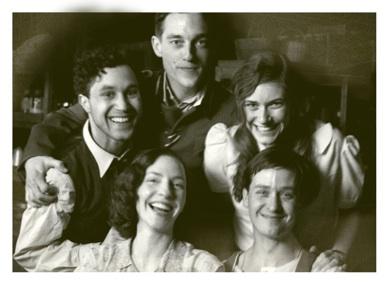
I just watched Generation War, A German miniseries about the lives of five young German friends in the throes of World War II.
In Germany, the series - whose original title, Unsere Mütter, unsere Väter (Our mothers, our fathers), is considerably more personal and confrontational, for Germans at least - has caused a lot of controversy and debate since airing there last year.
It has also been a great success though, both in Germany and abroad. Several foreign broadcasters have bought the series, among them the BBC, which showed it in April 2014. The U.S. rights were acquired by Music Box Films, which released it on DVD in May 2014. (i.a. available on Amazon).
Much of the critique has focused on the fact that none of the five friends is a nazi. Rather, they - two of them brothers serving as Wehrmacht soldiers on the East front, one a war nurse, one a Jewish tailor, another an aspiring singer - are portrayed as victims of circumstances beyond their control. Very little is shown of the enthusiasm and devotion with which the German people brought Hitler and the Nazi Party to power, or of the machinations of the totalitarian system, feeding the military-industrial complex through slave labor, conquest and destruction.1
Or of the fate of the Jews for that matter. The only Jewish part of the narrative, tailor Viktor, escapes from a train on its way to a concentration camp early on, through which “the tough question about the six million dead Jews is simply blanketed out”, as one journalist cynically noted in a Jewish newspaper.2
The show has also sparked controversy abroad (together with high ratings), most notably among the Poles, who were outraged about the fact that the Polish partisans are portrayed as at least as anti-Semitic as the Germans. In one scene for instance, the partisans succeed in taking a German train filled with guns, ammo and prisoners in striped pyjamas. They take the guns and ammo but reclose the boxcar doors on the pale, miserable prisoners.3 When Viktor - who has joined the partisans but concealed he is Jewish - opens the doors to let the prisoners go, he is immediately kicked out of the group, apparently lucky the leader even lets him go alive.
Ok, so the series isn’t entirely historically accurate; the Germans were more anti-Semitic, the Polish less anti-Semitic and 99,999% of the Semites were not able to hack their way through the floor of a boxcar on its way to one of the many concentration camps, much less join a group of Polish partisans. But the overarching message of Unsere Mütter, unsere Väter - that many ordinary Germans weren’t able to escape participating in the atrocities, that it wasn’t just the SS and the fanatics of the Nazi Party who did all the dirty work - that message clearly hit home (and a nerve), causing a shock wave in Germany even almost 70 years after the end of the war.
“Were German soldiers really so brutal?” Germany’s largest tabloid, Bild, asked after the episode that showed a Wehrmacht unit executing civilians in revenge for a partisan attack.
In her 1963 book Eichmann in Jerusalem: A Report on the Banality of Evil, the German philosopher Hannah Arendt held that Adolf Eichmann - one of the foremost organizers of the Holocaust, who was captured by the Israeli intelligence service Mossad in 1960 and subsequently tried, convicted and executed in Israel - was not primarily driven by anti-Semitism or hatred, but rather by careerism and obedience. According to Arendt, who followed Eichmann’s trial, Eichmann was “neither perverted nor sadistic but terribly and terrifyingly normal.”, and did the things he did because of his “quite authentic inability to think”. In other words, because he was stupid.
Though shocking at the time, Arendt’s observation that Eichmann was not a monster - as so many had wanted to believe - but just a normal guy, stopped short of admitting there was an Eichmann in all of us, by labeling the real Eichmann a shallow buffoon incapable of thinking for himself.
Generation War takes Arendt’s main point - that evil is often committed by normal, albeit simpleminded people - one step further, arguing they were also committed by intelligent normal people who were not overly ambitious or predispositioned towards obedience. Why? Was it their time in the Hitlerjugend, that brainwashed them, together with a hefty daily dose of propaganda at school, in the newspapers and on the radio? Was it perhaps a combination of specific German character traits?
No. They were just trying to survive.
I have to admit I felt sympathy for the two brothers when they had to shoot a captured prisoner from point blank range, one a Russian soldier, the other a local girl who possibly played a role in a bombing. I felt sympathy, because I knew it could have been me. It could have been me holding the gun. It could have also been me standing in front of it, but the human reality is such that there are far more of us trying to survive than there are trying to resist. Most of us do what we’re told. We prefer to do nothing, but if we are told to point and shoot, we do just that.
Think that’s ridiculous? Well, have you ever seen someone being beaten up, doing nothing? Ever seen a beggar sit shaking on a bench in the middle of a freezing winter, doing nothing? Ever learned your government was in the process of passing a law that you knew would fundamentally infringe on other people’s civil rights or your own, doing nothing?
Me too.
The reality is that most of us can be turned into monsters far easier than we would like to believe. An especially uncomfortable truth for many German sons and daughters who up to Unsere Mütter, unsere Väter had always thought their parents had lived through the war morally unscathed, since they had been neither in the Nazi Party nor in the SS.
But even though it happened to them, let’s not lull ourselves to sleep thinking it is also limited to them. Because the banality of evil lives in us all, just waiting to be called to duty.
1 Nicolas Büchse, Stefan Schmitz und Matthias Weber, Stern, Das gespaltene Urteil der Historiker. 23 March 2013.
2 Jennifer Nathalie Pyka, Jüdische Allgemeine, Opferneid als Dreiteiler. 21 March 2013.
3 Interestingly, the prisoners are not identified as Jews. They don’t say a word and aren’t wearing a yellow star. One of the Polish partisans says that “most of them are Jews” and that “Jews are just as bad as communists and Russians. Better dead than alive”. I think it is safe to say the writers cut corners here for the sake of the story (giving Viktor a reason to reveal himself as being Jewish by having him open the boxcar doors) because even the most ruthless, anti-Semitic combatants would make a little effort to find out if there were any ‘friendlies’ in the boxcars.

“Every mammal on this planet instinctively develops a natural equilibrium with the surrounding environment but you humans do not. You move to an area and you multiply and multiply until every natural resource is consumed and the only way you can survive is to spread to another area. There is another organism on this planet that follows the same pattern. Do you know what it is? A virus. Human beings are a disease, a cancer of this planet. You're a plague and we are the cure.”
Agent Smith, The Matrix
A recent, authoritative UN report on climate change concludes that catastrophic climate change can still be averted in the coming decades, by abandoning all dirty fossil fuels in favor of clean energy sources.1 As economist Professor Ottmar Edenhofer, who led the team responsible for the report, said: "It doesn't cost the world to save the planet".
But a growing number of environmentalist activists no longer believes world disaster can be averted and that the price would be too high even if it could. For them, humanity’s sins against nature go far beyond burning fossil fuels and gorging on nuclear power, including biogenetic engineering, synthetic biology, geoengineering and numerous other technological advances humans have come up with to manipulate their environment, their society and themselves.
The Dark Mountain Project (DMP) for instance, founded in 2009 and describing itself as a “network of writers, artists and thinkers who have stopped believing the stories our civilization tells itself”, therefore champions ‘uncivilization’ as the only true solution for the ecological, social and political collapse they feel is nigh. Last year, they even organized an Uncivilization festival, a “gathering of people searching for answers to questions about our collective future in a rapidly-changing and depleting world”.2
The description of the festival’s program oozes an elatedly romantic ‘back to nature’ sentiment, speaking of “wanderings in the woods”, workshops in scything and nights around campfires (an ancient form of fossil fuel burning).
In a recent article in the New York Times, one of DMP’s founders, Paul Kingsworth, explains that inspiration for the Dark Mountain Project came from the realization that it was no longer possible to “save the world”, because “the ‘human machine’ has grown to such a size that breakdown is inevitable.”3
Mr. Kingsworth’s idea of that ‘human machine’ seems to encompass much more than the global economy. It includes our instrumental view of - and perceived detachment from - nature, as well as the growing social inequality and the ever advancing globalization squeezing out local shops and farmers (a topic Mr. Kingsworth explored in his 2009 book ‘Real England’).
In short, it is everything about us.
So how elatedly romantic would things get if we gave Mr. Kingsworth the keys to the city? If we gave him and his followers from the Dark Mountain Project carte blanche to save the world? What would they do and where would they start, seeing as there is apparently so much wrong with our current civilization and so little right.
One suggestion might be to move everybody to the countryside, thus getting rid of all industrialization, globalization and the increasing technolization of civilization in one fell swoop, while simultaneously restoring man’s bond with nature.
Impossible, impractical, imperious? It has been done several times in one form or the other actually, perhaps most notably in Cambodia in the 1970s, when Pol Pot and his Khmer Rouge closed all factories, schools and hospitals, abolished banking, money and private property and relocated everybody to collective farms. It was not a big success though.
But while I don’t mean to compare the Khmer Rouge to radical environmentalism in any way, the question what the uncivilization environmentalists would do to heal civilization from its current diseased state - such as they perceive it - is still a legitimate one.
Would there still be planes, trains, automobiles, passports, supermarkets, space travel, concrete roads, imported food, affordable medicine, high-tech medical equipment, electricity, central heating and refrigerators in Mr. Kingsworth’s ideal world? The list of modern essentials we didn’t have before large-scale industrialization and globalization - while easy to disparage around a summer night’s campfire - goes on and on.
As the prominent English environmental journalist George Monbiot asked Mr. Kingsworth - an old friend of his - in a debate about ‘uncivilization’: “How many people do you believe the world could support without either fossil fuels or an equivalent investment in alternative energy? How many would survive without modern industrialization? Two billion? One billion? Under your vision, several billion perish. And you tell me we have nothing to fear.”4
At the same time Mr. Kingsworth’s books are also available in a paperback (a.k.a dead-tree) version via global corporation Amazon, while the Uncivilization Festival has a website and last year provided a shuttle bus to transport people to its location. It seems even those longing for uncivilization want to preserve certain benefits of industrialization, globalization, and technolization.
Perhaps it is time someone organized a Civilization Appreciation Day.
1 2014 report on climate change from the Intergovernmental Panel on Climate Change (IPCC)
2 Quotes from website uncivilisation.co.uk
3 It's the End of the World as We Know It....and He Feels Fine. Daniel Smith. New York Times Magazine. April 17, 2014.
4 Ibid.
20 Maart 2014
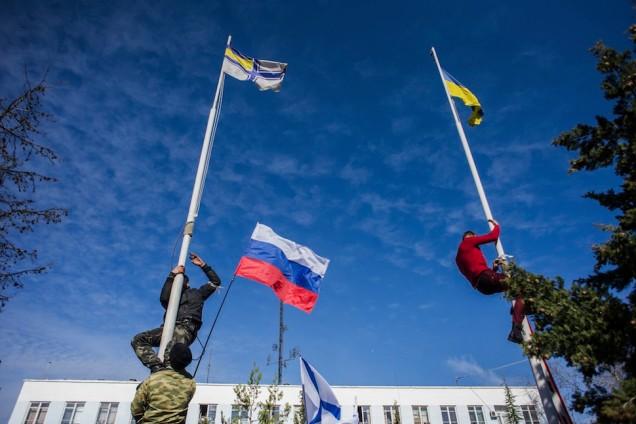
Referendum on Sunday, independence on Monday, annexation on Tuesday. This week Crimea rushed back to Russia. Was it all legal according to International Law?
Russian President Vladimir Putin said it was. In a speech on March 18, before signing the treaty with Crimea for the region to join the Russian Federation, Putin stated that: “A referendum was held in Crimea on March 16 in full compliance with democratic procedures and international norms.” And he should know, because he graduated from Leningrad State University in 1975 with a degree in International Law.
But how can a referendum about the future of a territory be in full compliance with democratic procedures if voters are not even given the option of keeping the status quo - in this case staying within Ukraine? (the options were either joining Russia or for Crimea to become an independent state)
Then again, even if there had been such an option, the majority of the Crimean population would probably still have voted for 'reunification' (as it was stated on the ballot) with Russia, since about 60 percent of the population is Russian.
Of course, unlike with the current referendum, the 24 percent Crimean Ukrainians and 12 percent Crimean Tatars might have very well showed up for the referendum if they could have voted ‘no’. In that case the likely result would have been 60 percent in favor of reunification and 40 percent against, not nearly as impressive as the 97 percent the (pro-Russian) Crimean government claimed as the result of the current ‘yes’ / ‘yes please’ referendum.
In the same speech Putin also said that “in people’s hearts and minds, Crimea has always been an integral part of Russia.” But although the (Russian) people may very well feel this way, history shows the love affair to have been considerably less lengthy and monogamous than Putin’s amorous declaration suggests.
Fact is that Crimea has been governed, owned, occupied, or worse by every self-respecting kingdom, empire and city state with access to the Black Sea during the past 3,000 years, including the Scythians, the Dorians, the Ionians, the Romans, the Goths, the Huns, the Bulgars, the Khazars, the Kievan Rus’ federation, the Byzantine Empire, the Kipchaks, the Mongols, the Republic of Genoa, the Crimean Tatars, the Ottoman Empire, the Russian Empire (which annexed Crimea in 1783), the U.S.S.R, Nazi Germany, the U.S.S.R again, Ukraine, and finally the Russian Federation.
But let’s forget all that for a moment. Let’s forget that the referendum was not “in full compliance with democratic procedures and international norms”, that the whole process was rushed, that political opposition was squashed and that the Ukrainian national government was not consulted in any way. Let’s also forget that Russia established a military presence in Crimea in the weeks leading up to the referendum - occupying airports, surrounding Ukrainian military bases and guarding roads - which is clearly in violation of the international law principle of territorial integrity1.
Let’s forget all that and concentrate on the real question: does Crimea have the right to self-determination?
Article 1 of the International Covenant on Civil and Political Rights2 states: “All peoples have the right to self-determination. By virtue of that right they freely determine their political status and freely pursue their economic, social and cultural development.”
All peoples. It sounds so simple. But of course nothing is simple when there is so much at stake.
There is no consensus in the international law community on the definition of ‘peoples’. According to a report about the implementation of the right to self-determination - organized by the UNESCO Division of Human Rights, Democracy and Peace - “The plain meaning of the term “all peoples” includes peoples under colonial or alien subjugation or domination, those under occupation, indigenous peoples and other communities who satisfy the criteria generally accepted for determining the existence of a people.”3
In her article Does the Principle of Self-Determination Prevail over the Principle of Territorial Integrity?, Vita Gudelevičiūtė proposes the (very broad) definition of “a people” as “a whole population of a particular territorial unit”.4
Following this definition, the Russian population of Crimea would indeed be able to claim the right to self-determination under International Law.
But an uncomfortable question nevertheless keeps gnawing on my legal mind.
What of the right to self-determination of the Crimean Ukrainians and Tatars?
1 Article 2.4 of the United Nations Charter.
2 In force since 1976. Signed and ratified by all but 25 states. North Korea has signed and ratified but has since stated it wishes to withdraw from the Covenant. Russia has signed and ratified the Covenant, as has Ukraine.
3 The implementation of the right to self-determination as a contribution to conflict prevention, Report of the international conference of experts organized by the UNESCO Division of Human Rights, Democracy and Peace and the UNESCO Centre of Catalonia (21-27 11 1998, Barcelona)
4 Does the principle of self-determination prevail over the principle of territorial integrity? Vita Gudelevičiūtė. International Journal of Baltic Law. Volume 2, no.2 (April 2005) ISSN 1648-9349