
new

If Donald Trump loses the election on Nov. 8, he will not have lost it on the issues.
He will have lost it because he made fun of disabled people, insulted a Gold Star mother, fat-shamed a Miss Universe, was caught on audio tape giving his views on genital grabbing (it's OK if you're a celebrity), and was confronted with several women accusing him of sexual assault in the past, with some incidents going back 30 years.
And yet for a large group of voters he became their hero - and remains their hero - despite these and other scandals, insults, and faux pas. Why?
Because they're scared. Scared about their jobs disappearing to lower-wage countries; being replaced by robots working faster and more efficiently than humanly possible; being pushed out by immigrants willing to work for less; and having to cede ever more ground in the decades-long culture war with the liberals.
They are looking to Trump, because when it comes to the worries and frustrations of the blue-collar workers, Hillary Clinton still hasn't put two and two together, judging from the-now infamous-remark about the "basket of deplorables" made at a fund-raiser in New York last month.
If you will remember, Clinton said you could put half of Trump's supporters into "the basket of deplorables . . . the racist, sexist, homophobic, xenophobic, Islamophobic - you name it . . . they are irredeemable, but thankfully they are not America." She then went on to say that "the other basket [were] people who feel the government has let them down, the economy has let them down, nobody cares about them, nobody worries about what happens to their lives and their futures, and they're just desperate for change."
She apologized, of course, but the remarks nevertheless offered a rare insight into Clinton's understanding (or lack thereof) of the difficult journey millions of Americans have been on for the last 20 or 30 years.
When the remarks surfaced, the media focused all their attention on the dismissive albeit catchy phrase "basket of deplorables." But the second part of what she said was actually the most interesting, because it showed Clinton apparently doesn't realize that there is no other basket.
There is only one basket and the people who are unfortunate enough to be in it are not deplorable, they are vulnerable. They have become increasingly racist, xenophobic, and Islamophobic because the economy has let them down and they are worried about their own and their children's futures.
The difference with the remark - equally infamous - of then-Sen. Barack Obama about the same group of people is both subtle and striking. Speaking at a fund-raiser in San Francisco in 2008, Obama said about people in the Midwest whose jobs had been gone for 25 years: "And it's not surprising then they get bitter, they cling to guns or religion or antipathy toward people who aren't like them or anti-immigrant sentiment or anti-trade sentiment as a way to explain their frustrations."
These people were once part of the middle class, but while Clinton took up residence in the White House as first lady, became senator for New York, campaigned for the Democratic presidential nomination, flew around the world as secretary of state, and gave $250,000 speeches to Wall Street banks, they lost their jobs, their savings, their pension, their house.
And their situation is not improving. On the contrary, they are being crushed from all sides.
Immigrants are competing for their jobs, environmental regulations are killing their jobs, technological advancements are replacing their jobs and lower-wage countries are stealing their jobs. The simple, alarming reality is that the economic value of the blue-collar worker in the developed world is rapidly approaching zero. They are the losing class.
Desperate for a way out, they have found themselves a champion in Donald Trump. And although he may not be the ideal spokesman, at least he is not talking about them like they are some unfortunate nuisance, a leftover relic from a less enlightened time. At least he is talking to them.
Meanwhile, Clinton dreams of "a hemispheric common market, with open trade and open borders" and actively aims to "put a lot of coal miners and coal companies out of business." But while most economists agree this is the right approach from a macro-economic perspective, the long-term trade and environmental benefits will not go to those unemployed blue-collar workers struggling to make ends meet right now.
Obviously there is nothing Clinton or anybody else can do about that. But since she is running for president of the United States and intends for the economy to continue on this path, it is her responsibility to defend and explain it, instead of frantically trying to duck and take cover whenever the issues of free trade, globalization, and the declining economic value of blue-collar labor comes up.
Interestingly, both Trump and Bernie Sanders fundamentally disagree with Clinton on key elements of her economic and societal vision. Trump favors protectionism and deregulation to invite (force) companies to bring back production to the United States, and make coal mining economically viable again - something most energy experts agree is highly unlikely. For his part, Sanders is also against globalization, but contrary to Trump, he favors a much larger role for the government, to redistribute income and close the gap between the haves and have-nots.
Who is right? Which economic policy do we want the government to pursue for the next four to eight years? Clinton's "rational economics," Trump's neo-mercantilism, or Sanders' European-style socialism?
What will be the long-term effects of these policies for American companies? What are the main benefits and drawbacks for different groups of Americans and what, if anything, will be the effect on taxes and the national budget?
These are important questions and the voters want to see them discussed (a recent New York Times survey showed the second most important question for its readers was about how to reduce extreme income inequality). So perhaps we could all dispense with the character assassination game for 72 hours and instead focus on the nominees' economic policies and what they will mean for ordinary Americans in a fast-changing world.
We should have this discussion. Because if we don't, it's only a matter of time before a new Trump rises up. And with any bad luck, he will not be the genital-groping kind.
This article was first published on philly.com, on October 25, 2016. It also appeared in print on October 25, 2016, in the Philadelphia Inquirer.
Other media that published the article: Knoxville News-Sentinel, Albaquerque Journal, Wichita Falls Times-Record, The Daily World, Northwest Georgia News and others.

The last time a large part of the electorate refused to accept the clear results of a presidential election, it triggered the start of the Civil War.
And although another civil war is unlikely, the chance that the results of this year’s presidential election will not be accepted by a large part of the electorate has emerged as a real possibility over the last few weeks.
GOP nominee Donald Trump has repeatedly said he can only lose the elections if they are rigged, while also implying he might not accept the results in case of defeat. Add to this the results of a recent poll conducted by AP-NORC which showed close to sixty percent of Trump supporters fear there will be extensive voter fraud this election, and you have two key ingredients of a potentially explosive post-election season.
The Democrats, for their part, have voiced growing concern that the Russians might try to hack the elections, believing the government of President Vladimir V. Putin prefers Donald Trump to become the next U.S. President.
Senate minority leader Harry Reid of Nevada, for instance, wrote in a letter to FBI Director James Comey on August 27, he had “become concerned that the threat of the Russian government tampering in our presidential election is more extensive than widely known and may include the intent to falsify official election results.”
Senator Reid sprinkled his letter with several semi-accusations and odious tie-ins of the Kremlin with the Trump campaign, all but suggesting the Russians would love nothing more than to see Donald Trump as President of the United States.
Reid also called Trump an “unwitting agent’ of Russia and the Kremlin”, but by voicing his concerns so publicly he has possibly become an unwitting agent of the Kremlin himself. Though, in the Senator’s defense, when it comes to the shadowy game of disinformation and soft subversion, a career politician from Nevada can hardly be expected to be a match to the former KGB Lieutenant Colonel who has ruled Russia for the past sixteen years.
What does Vladimir Putin really want? Is it really so important to him to have as his main adversary a highly unpredictable, politically inexperienced, irrational narcissist with an inflammable temperament—instead of a reasonable, rational individual proven to be skilled at reaching a compromise, while also reluctant to risk overplaying her hand? So important he would risk a deep diplomatic crisis over it with the most powerful country in the world?
If so, it would certainly be a departure from the shrewd, strategic behavior Mr. Putin has displayed these past years, such as annexing strategically important Crimea without suffering military casualties, supporting the rebels in eastern Ukraine to advance Russian interests there, while stopping short of triggering a full-scale war with Ukraine, testing the NATO defense readiness and response levels through military posturing, using propaganda to sow doubt and division between NATO member states, and stabilizing the position of Syrian President Bashar al-Assad against relatively low cost and with minimal casualties. And yet, there is certainly evidence that points to the Kremlin being up to something with regards to the U.S. presidential election.
There was the hacking of the emails of the Democratic National Committee, published by WikiLeaks on July 22. WikiLeaks did not reveal the source of the leaked emails, but U.S. intelligence agencies were quick to conclude with “high confidence” that the Russian government was behind the hack. They are probably right.
And on August 18, the FBI Cyber Division issued a ‘flash’ alert saying a state’s Board of Election website had been probed and penetrated between late June and mid-July, which had led to exfiltration of voter registration data. Another state’s Board of Election website had been penetrated in August, but there the hackers had not exfiltrated any data. Yahoo News reported that sources familiar with the FBI bulletin had said the first state was Illinois—where the personal data of up to 200,000 state voters had been downloaded—and the second Arizona.
According to Rich Barger, chief intelligence officer for ThreatConnect, a cyber security firm, the methods and types of hacking tools used to scan for vulnerabilities in the state election systems appeared similar to those used in other suspected Russian state-sponsored cyber-attacks, including the hack of the World Anti-Doping Agency, early August. The FBI was said to investigate a “possible link” between the DNC hack and the malicious penetration of the voter registration databases in Arizona and Illinois.
So, was it just sloppy of the Russian hackers to use the same methods and tools they had used in other suspected Russian state-sponsored hacks, or was it merely a tactical gambit, meant to establish intent and credible capability?
Unfortunately, tampering with the presidential election is easier than one might think, because all but two states follow the winner-take-all system, awarding all of a state’s Electoral College electors to the candidate that wins the plurality of the vote. Manipulating the election process in just a few well-chosen counties could in some cases thus swing an entire state. Add to that the fact that presidential elections are usually decided in a handful of battleground states and it becomes clear a few counties could even sway the entire election.
Making matters worse is that in 2016, several swing states—including Colorado, Virginia, Pennsylvania, Ohio and Florida— will still be using digital voting machines that hacking experts have demonstrated could be hacked in under a minute. Such machines could be easily infected with a self-duplicating code, which then spreads from machine to machine through an administrator card.
But precisely because it is relatively easy to hack the elections—and everyone knows it—Putin doesn’t actually have to do it. He only has to convince the American public that he intends to do it (because he wants The Donald to be the next President) that Russian hackers could pull it off (Arizona, Illinois hacks) and then make it look like he did it.
If that was the main goal of these summer hacks, it certainly worked. Because Senate minority leader Harry Reid, the federal government, the Clinton campaign, the Trump campaign, the Central Intelligence community, they have all loudly expressed grave concerns the elections will somehow be tampered with.
To actively disrupt the presidential elections—without actually interfering—Putin would also need a reliable conduit to spread the rumor that the elections have indeed been hacked.
This is where WikiLeaks comes in. Whoever leaked those 19,252 emails and 8,034 attachments from the Democratic National Committee to the Whistleblower in Chief in July, gained the trust of a reliable, independent journalistic organization perceived by many as being more trustworthy than any other news source, be it commercial or government-based.
And so the board is set and all the pieces have been moved into position. Within a few days or weeks after the election, the hacker who leaked the DNC emails could leak new documents to WikiLeaks, this time revealing convincing (though falsified) evidence of extensive hacking of hundreds of paperless digital voting machines. Finding no such evidence, the U.S. Central Intelligence community will deny these attacks in fact happened, but who would the public—especially those who just voted for the candidate that lost—believe?
Should Clinton win the election in this scenario, Trump would take the bait of alleged voter fraud faster than a mousetrap can snap shut. Saying he has claimed all along he could only be defeated in case of foul play, he would rally his tens of millions of hard-core supporters and demand nothing less than a do-over.
Clinton would likely demand the same in the event of a Trump victory. Either way, the nation would be dangerously divided and neither candidate would have a clear mandate to lead the nation.
The only real winner would be Vladimir Putin, who, after having successfully executed a dirt-cheap disinformation plot that would have made his old KGB superiors proud, would walk away scot-free, because Washington would be forced to continue denying any election tampering had taken place.
Checkmate.
This article was published earlier on The Hill, titled 'In political chess game with Putin, even Trump is a loser'
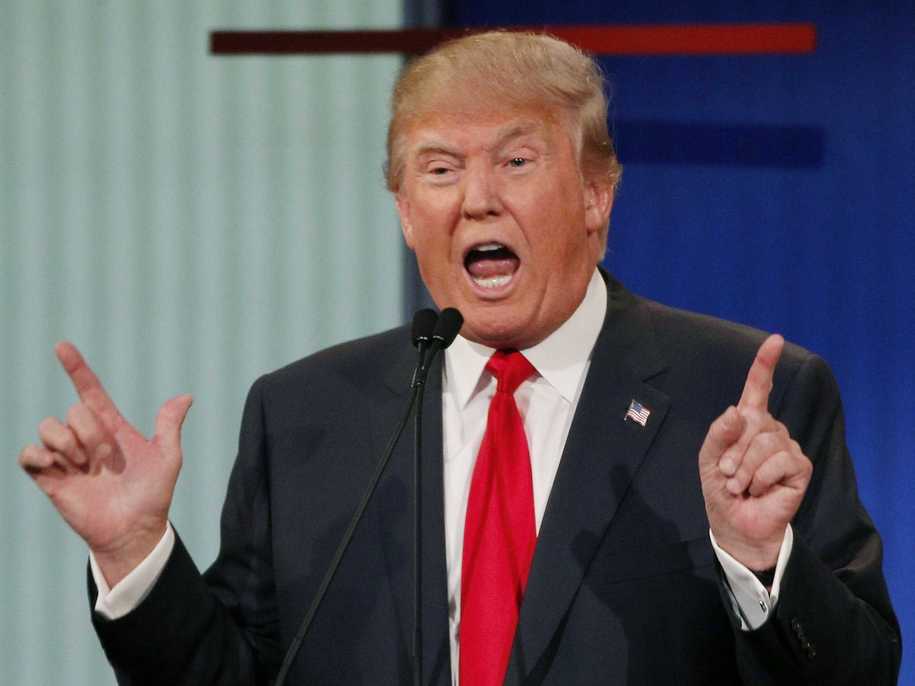
Let’s not beat around the bush. This is no ordinary election, it’s a battle for America. We have two very different presidential candidates, who are selling two very different visions of the kind of America we had in the past, the kind of America we have right now, and the kind of America we should have in the future.
In the blue corner we have Hillary Clinton, who basically wants to continue on the path we have been on for the past eight years, while acknowledging that a lot remains to be done. And in the red corner we have Donald Trump, who argues we are very much on the wrong path and that Americans—well, a majority of Americans anyway—were better off in the 1950s, when American-made products still ruled the global economy and blue collar workers could be part of the middle class, when American military might was unrivaled, Mexicans lived in Mexico and Muslims lived, well, somewhere else.
For the last couple of weeks, Republicans have been asking themselves in growing desperation how it is possible that Hillary Clinton is still favorite to win the election after all the lying, the private email server scandal and the air of corruption surrounding her time as Secretary of State (with aides allegedly providing access to the Secretary for big Clinton Foundation donors).
As Donald Trump Jr. put it: “They [the media] have let her slide on every indiscrepancy [sic], on every lie, on every DNC game trying to get Bernie Sanders out of this thing. If Republicans were doing that, they’d be warming up the gas chamber right now.”
The reason is this, Donald Jr.: voters don’t like Hillary Clinton, they don’t believe Hillary Clinton and they don’t trust Hillary Clinton, but there is one thing about her they know to be true: electing her will keep your dad out of the White House.
In other words, when all is said and done, this election is not about accepting Clinton and her vision for America, it is about rejecting Trump and his vision for America.
But.
There is nothing Donald Trump could do that would make him seem more trustworthy, more measured, more experienced, less confrontational, less offensive. Same goes for Clinton. Those trains have left the station.
The only thing left for Mr. Trump to do, is to convince voters that his vision for America is the right vision. That we have every reason to fear an increase of terrorist attacks if we allow Syrian refugees—and people from other predominantly Muslim countries—to continue to “pour into the country.” That we have grown weak, allowing our military to be hollowed out in a time we need more, not less, military might. That it is time to return to an America first policy.
Should Mr. Trump succeed in doing just that, the tables would turn and all his descrepancies would be forgotten. He would be the favorite to win, no matter what he would do or say, no matter what damaging information would surface about his past business dealings, because voters would still subscribe to his vision for America.
For that to become reality, though, something would have to happen that is so big, it would force everyone to recalibrate—or at least consider recalibrating—their existing world view. The kind of event that makes people say: “Look, I’ve always been against/for that policy, but after this happened I have to seriously reconsider.”
A mere political scandal or grand gesture will likely not be enough to fundamentally upset voter’s minds so late in the game. Historically, the effect of that kind of October Surprise has generally been overestimated. But when it’s something that could be sold as a real game changer, all bets are off.
Think Pearl Harbor, which swayed American public opinion in favor of entry into World War II. The attacks of 9/11, which generated overwhelming public support for the passage of the PATRIOT Act and the ensuing wars in Afghanistan and Iraq (of course, nowadays it’s next to impossible to find anyone who admits they supported the wars back then, but in the early days public support for the war in Afghanistan was over 90 percent and for the war in Iraq over 70 percent). And the collapse of Lehman Brothers, on September 15, 2008, which turned a deadlocked presidential contest into a solid lead for Barack Obama.
Now, if a 9/11-style terrorist attack were to happen late October, early November, in other words days before the election, how would that play out? How would it impact the election? Remember the public mood during those first days, weeks following 9/11? The horrific incidences of violence against Muslim Americans, the suddenly heightened sense of insecurity, vulnerability, nationalism, the broad support for the invasion of Afghanistan?
Hold on to that for a moment as you read the responses of Hillary Clinton and Donald Trump just after the New York bombings of September 17, 2016.
“I have been briefed about the bombings in New York and New Jersey and the attack in Minnesota. Obviously we need to do everything we can to support our first responders, also to pray for the victims. We have to let this investigation unfold. We have been in touch with various officials, including the mayor's office in New York, to learn what they are discovering as they conduct this investigation. And I will have more to say about it when we have some facts.”
“This is something that will happen, perhaps, more and more all over the country. Because we’ve been weak. Our country’s been weak. We’re letting people in by the thousands and tens of thousands. We’re allowing these people to come into our country and destroy our country, and make it unsafe for people. We don’t want to do any profiling. If somebody looks like he’s got a massive bomb on his back, we won’t go up to that person ... because if he looks like he comes from that part of the world, we’re not allowed to profile. Give me a break.”
Remembering how you felt during those first few days after 9/11, who would you vote for in the immediate aftermath of a terrorist attack?
Now assume you are an undecided or NeverTrumper.
This article was published earlier on American Thinker and DailyKos.

Earlier this year, a mentally disturbed British national tried to assassinate Donald Trump by grabbing a police officer’s gun at a Trump rally in Las Vegas. Like most mentally disturbed would-be assassins, he failed.
(...)
But although the chance of mentally disturbed and/or left-wing extremist amateurs assassinating Donald Trump is remote, the potential threat from another, far more powerful, rational and exclusive group could prove more serious.
This article was published on Dailycaller.com. Read the rest of this article at The Daily Caller.

The news that Democratic nominee Hillary Clinton has pneumonia, immediately kicked off speculation about what would happen if Clinton needs to be replaced for health reasons. It would also be the first time in more than 220 years of U.S. presidential history that a presidential nominee of a major political party withdraws before the election.
One presidential candidate died weeks after the general election—Horace Greeley, in 1872, after having lost the election against President Ulysses S. Grant—and one vice presidential candidate withdrew from the ticket—Tom Eagleton, in 1972. But the nation has so far been spared odd, head-scratching scenarios such as presidential nominees falling seriously ill, being arrested or even dying weeks before the general election, or after the general election but before the Electoral College votes, or after the Electoral College votes but before the inauguration. Of course, on a long enough time line, these scenarios will eventually become reality.
Now, should Clinton be forced to withdraw before the general election for whatever reason, it would be up to the Democratic National Committee to decide who will replace her. Per the DNC Bylaws (Article 2, Section 7) the DNC would convene a special meeting “on the call of the Chairperson”, to vote on a new candidate. Whoever wins the majority of that vote would become the nominee. In other words, the current Democratic vice presidential nominee, Tim Kaine, would not automatically go to the top of the ticket.
If Clinton would have to be replaced after winning the general election but before the Electoral College votes—which in 2016 will be on December 19—the situation gets more complicated, because there is no federal law that prescribes how Electors should vote. The U.S. Supreme Court has held that political parties may extract pledges from Electors to vote for the parties’ nominees, but that could still leave them free to elect another candidate if the one they pledged to vote for is no longer available, meaning Clinton’s electoral votes could be split between several people--with all the political consequences that might entail.
In the event a candidate dies after the Electoral College has cast its vote but before the inauguration, the 20th Amendment states that the vice president-elect becomes the president-elect. It is not clear, however, whether a candidate assumes the title ‘president-elect’ immediately after the Electoral College vote, or only after a joint session of Congress (on January 6) has officially declared a winner.
Of course, chances are Hillary Clinton will make a full recovery and will be on the ballot herself as the Democratic presidential nominee at the time of the general election. But what if she is not? Who would the DNC likely vote for as her replacement?
The two logical candidates to replace Clinton would be the current vice presidential nominee Tim Kaine and former presidential candidate Bernie Sanders.
Kaine is considered a mainstream Democrat, a centrist who is acceptable to both the moderate right and left. Having served as mayor of Richmond, Governor of Virginia and Senator from Virginia, he has both legislative and executive political experience. He has also served as DNC Chairman and at 58 is a lot younger than Bernie Sanders (75), which could be an argument when considering the replacement of a candidate because of health issues.
Kaine’s primary weakness when compared to Bernie Sanders is equally obvious: he didn’t run for president. Sanders did, and although he lost, nobody can deny Bernie gave Hillary a run for her money (and a lot of money it was). By all accounts he lost only narrowly, especially when discarding the votes from the super delegates.
And then there is the fallout from the DNC email scandal, which showed DNC staffers were clearly biased against Sanders, or at the very least preferred Clinton. Should the DNC pass over Sanders for Kaine when deciding on Clinton's replacement, it will likely infuriate the Bernie Sanders supporters to the point of organic, non-violent, Instagram explosion.
In fact, should Clinton withdraw, Sanders’ grass roots supporters could very well be the decisive factor for the DNC to vote him to the top of the ticket. Because in an election that will likely be determined by whoever is the most successful in getting their supporters to the polls, Sanders’ predominantly young, enthusiastic and tech-savvy suporters are a force to be reckoned with.

990 people were shot dead by the police in the United States in 2015. I know your first question. How many of them were black. But that shouldn’t be the first question. The first question should be: why so many?
In Germany, a country of 80 million people, it was 8. In the United Kingdom, it was 3.1 That’s right, 3. A country of 65 million people, and only three fatal police shootings in a whole year. In other words, a U.S. citizen is 67 times more likely to be fatally shot by the police than a British citizen.
Other European countries have similarly low numbers of fatal police shootings. So why are U.S. police officers so much more violent and aggressive than their European counterparts? (Japan and China also count virtually no fatal police shootings on an annual basis).
The short answer: because they have to, because they are trained to be and because they are allowed.
Because they have to
U.S. citizens own more than 300 million firearms. As of 2015, more Americans die of gun violence than of traffic accidents. Whether mentally insane, a former inmate of Guantanamo Bay, a vocal admirer of ISIS and/or perennially on the no-fly list, you can still legally arm yourself with an AR-15, or —if you prefer to go more stealthily—a nice Glock 17 with a couple of 17 round magazines.
With so many guns around, the police are right to assume that whoever they approach, there is a fairly high chance they will be armed—especially in gun-friendly states. In fact, 782 of the 990 victims of deadly police shootings in 2015 were indeed armed with a deadly weapon, a whopping 79 percent.2 In 73 percent of the cases an attack was in progress, and roughly half of the people who were fatally shot fired first themselves, prompting police officers to return fire, in order to protect themselves and others.
In Europe, gun ownership is much, much, much lower. Yes, the bad guys can still get guns and there have been terrorist attacks and organized crime shootings with machine guns in several European countries, but the vast majority of Europeans have never even held a weapon, let alone fired one or owned one.
No wonder European police officers approach a traffic violation, a domestic dispute or a fight in a parking lot differently than their American counterparts: they simply have far less reason to fear they are entering into another volatile situation with armed civilians.
Because they are trained to be
U.S. police officers receive far less training than their European counterparts, and the training they do receive is mostly geared towards using force, rather than conflict de-escalation.
U.S. police academies on average provide 19 weeks of classroom instruction to their recruits, a 2006 report from the Justice Department3 shows, while the average recruit received almost 20 times as many hours in using force than in conflict de-escalation.4 That stands in sharp contrast with national police academies in countries like Germany, Norway, Finland and the Netherlands, where future police officers are trained for three years and receive ample training in how to solve conflicts without the use of force.
In a profession that encounters distraught, confused, stressed and infuriated individuals on a daily basis, it stands to reason that spending (much) more time on learning how to defuse tensions without using a gun is one way to decrease the number of fatalities inflicted by the police.
Another is to increase the emphasis on using non-lethal weaponry. In countries like Germany and the UK, police officers receive more training in using non-lethal weapons such as pepper spray and the baton, which are often sufficient to neutralize a perceived threat. In the case of the shooting of Philando Castile, for instance, the police officer who fired was so close he could have easily used pepper spray when he thought Castile was reaching for his gun, instead of shooting him in his arm four times.
There is also something to be said for (re-)training police officers in using potentially lethal force with more constraint. Examples where U.S. police officers fired 90 or more bullets to kill a single suspect are plentiful. They become almost grotesque when considering that in 2011, the entire German police force fired only 85 bullets to protect and serve a country of 80 million people.5 Of those 85 bullets, 49 were fired in the air as warning shots and 36 were actually fired at civilians, 15 of which resulted in injuries and 6 in fatalities.
Because they are allowed
In the 1989 landmark case of Graham v. Connor, the U.S. Supreme Court ruled that use of force by law enforcement officers needs to take into account the “severity of the crime at issue, whether the suspect poses an immediate threat to the safety of the officers or others, and whether he is actively resisting arrest or attempting to evade arrest by flight.”6
And: “The "reasonableness" of a particular use of force must be judged from the perspective of a reasonable officer on the scene, and its calculus must embody an allowance for the fact that police officers are often forced to make split-second decisions about the amount of force necessary in a particular situation.”7
In other words, if the officer on the scene can reasonably perceive imminent and grave harm at that time, he is authorized to use lethal force.
By contrast, in most European countries police officers can only use lethal force when it is “absolutely necessary”, i.e., when the suspect poses an immediate, lethal danger and the police officer has no other option to neutralize the threat.8 By this standard, the fatal shooting of Alton Sterling—who had reportedly threatened someone with a gun but was not brandishing it when confronted by police officers and was fatally shot multiple times in a subsequent altercation with the officers after they had wrestled him to the ground—would likely not stand up to scrutiny.
The same is likely true for the case of Philando Castile, as it was not clear Castile was reaching for a weapon instead of his driver’s license and—at least according to the story of his girlfriend—the police officer had not ordered Castile to stop moving as soon as he started reaching for something (also, shooting him four times seems rather excessive).
As to the question of racism: of the 990 people fatally shot by the police in the United States in 2015, 494 were white, 258 black, 172 hispanic, 38 other and 28 unknown.9 So yes, a disproportionate number of the victims were black. But stepping up training police officers in conflict de-escalation, even increasing gun control, will be a hell of a lot easier to realize than ending racism in America.
Photograph: www.victoriaadvocate.com/news/2014/mar/30/open_carry_march_ss_033114_236205/
- www.inquest.org.uk/statistics/fatal-police-shootings
- www.washingtonpost.com/graphics/national/police-shootings/
- www.bjs.gov/content/pub/pdf/slleta06.pdf
- Re-Engineering Training on Police Use of Force. Police Executive Research Forum. August 2015. Policeforum.org
- www.theweek.co.uk/crime/46907/us-police-fire-more-bullets-month-germans-use-year
- Graham v. Connor, 490 U.S. 386 (1989), Pp. 490 U. S. 396-397
- Graham v. Connor, 490 U.S. 386 (1989), Pp. 490 U. S. 396-396
- European Convention on Human Rights, article 2.
- www.washingtonpost.com/graphics/national/police-shootings/

A book wants to be read. It wants to travel, experience new things, meet new people. No book wants to be bought, half-read, and then spend six months on a nightstand with a bunch of other half-read books, before being put away at that place where books go to be forgotten, sometimes for decades: the bookcase.
Every thing has a function. The function of a book is to be read, the function of a bookcase is to be filled with books. By function, the two are mutually exclusive. A book cannot be read and fill space in a bookcase at the same time.
Books that are in the process of being read also rarely find themselves on a shelf. They lie on desks, coffee tables, dinner tables, the aforementioned night stand, toilet floors. Like pets, they travel with their owner, held in hands, pockets, backpacks. They are read in trains, buses, subway cars, at the office, in the park. They are folded, wrinkled, besmudged, creased. Until finished. After that it’s the bookcase, because we like to keep.
But what if we would not keep—it? What if we passed it on? To a friend, or an acquaintance who we think might like it. A stranger on the train. And what if they, in turn, would do the same? What would happen to the book? What kind of people would it meet, how far would it travel?
To find out, I had 40 special copies printed of my latest book, World 2.0: A History from Enlightenment to Terrorism and Beyond. Each copy has a special page, requesting readers to add their name, location and date of reception to the page, and give the book to someone else after they have finished it. In addition, readers are asked to write a short review on Amazon and include their copy number —which I put on the top right of the special page—and the location where they got the book. This way, readers can keep track of the travels of ‘their’ copy even after passing it on.
Will it work? I have no idea. But after reading this, how awesome would it be if you’d come across one of those 40 copies of World 2.0: A History in a pub on Fleet Street, or on a train departing from Grand Central Station, or when someone handed you a copy on the steps of the Sacré-Coeur overlooking Paris, in Bryant Park on a lazy sunny afternoon, or at a bar next to Piazza del Campo.
I hope that if you do, the book is filled with entries from those before you and marked with the unmistakable telltale signs of heavy reading, long journeys, and strange adventures in strange lands. Folded, wrinkled, besmudged, creased.
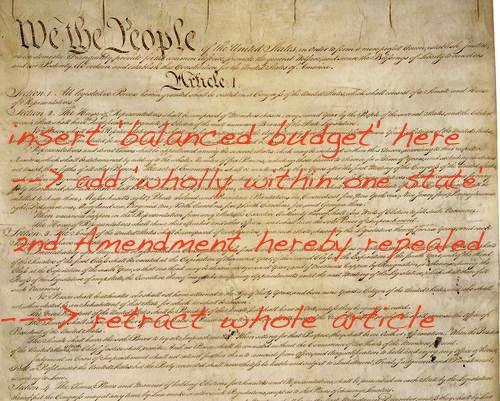
When you are faced with a no-win scenario, there are only two ways to avoid losing: refusing to play or changing the rules.
Realizing they are losing the battle for (their kind of) America, Republicans — perhaps mindful of what transpired 150 years ago — have begun organizing themselves around door number two, changing the Constitution.
More precisely, changing it back.
The first constitution, the Articles of Confederation (AoC), first drafted around the same time Thomas Jefferson penned The unanimous Declaration of the thirteen united States of America, had everything a 21st century Republican could wish for: a powerless Congress — it couldn’t even tax and needed a 9/13 majority to pass any law — no Supreme Court with the power to invalidate state laws and no executive branch to enforce acts of Congress. In short, a federal government that really was small enough to drag it into the bathroom and drown it in the bathtub, as Grover Norquist once famously said.
It was also hopelessly ineffective, though. Article II of the AoC read: “Each state retains its sovereignty, freedom, and independence, and every power, jurisdiction, and right, which is not by this Confederation expressly delegated to the United States, in Congress assembled.” What the Articles of Confederation created, therefore, was a United States in name only, a “firm league of friendship” (as the Articles called it) between thirteen independent, sovereign countries.
Of course when the Articles were ratified, in 1781, the Thirteen Colonies were still fighting for their independence from the British Empire, and it was perfectly understandable they had no desire exchanging one meddling, central government that was forcing all kinds of ridiculous taxes down their throat for another.
But understandable or not, founding the United States on the principle of sovereignty for individual member states also proved highly impractical. It led to frequent disputes between the states, foreign policy conundrums — because some states entered into agreements with non-U.S. states on their own — a weak military and unstable state economies, because each member state printed its own money and competed with the others when trading with the European powers.
The original mission of the Constitutional Convention of 1787 — to revise the Articles of Constitution — was doomed to fail, because the first constitution was founded on a logical fallacy: shared sovereignty.1 The solution was to either stop pretending and abandon the concept of the ‘United’ States altogether, or to double down on it and create a strong central government, with the supreme legislative power — including the power to tax — vested in Congress, the executive power in a President and the judicial power in a Supreme Court.
The new Constitution thus decided the fundamental disagreement about the nation’s political organization between the so-called Federalists and Anti-Federalists, in favor of the former, though tension between the two sides remains to this day.
Having said that, no sensible Republican (i.e., Anti-Federalist) would want to replace the current Constitution with the Articles of Confederation. Conservatives calling for a new Constitutional Convention want to curb the legislative power of Congress and judicial power of the Supreme Court, not abolish it.
And they have a point, considering that the reason to change the Articles of Constitution at the time, was to strengthen the United States military, economically and organizationally. Is it (still) really necessary, then, that Congress has the power to regulate activity that occurs wholly within one state? Is it so unreasonable to demand that Congress balance the budget? To allow states to decide whether they want to allow abortion, gay marriage, marijuana in their own state? Yes, to most Democrats these are all no-no’s, and to give Republicans salivating over a constitutionally mandated balanced budget and increased states’ rights a quick reality check: none of it will be possible without Democratic support. Here’s why.
Changing the Constitution is notoriously difficult. Article V of the Constitution reads:
“The Congress, whenever two thirds of both houses shall deem it necessary, shall propose amendments to this Constitution, or, on the application of the legislatures of two thirds of the several states, shall call a convention for proposing amendments, which, in either case, shall be valid to all intents and purposes, as part of this Constitution, when ratified by the legislatures of three fourths of the several states, or by conventions in three fourths thereof, as the one or the other mode of ratification may be proposed by the Congress (…)”
These days, having two thirds of both houses agree on the color of a pink elephant would already be historic, let alone getting them to agree on an amendment to the Constitution, so that’s out. Getting two thirds of the states to call for a convention is more feasible for Republicans though, which is why they are concentrating their efforts on this path. Two reasons:
1 — The electoral problem of the Republicans is not that there aren’t enough red states, but that there aren’t enough people living in them. 2 — Article V of the Constitution talks about the “application of the legislatures of two thirds of the several states.” (34 of 50 states). Unlike a vote in Congress, which is always a snapshot, the collection of the required 34 applications for a Constitutional Convention may take years. In 2004, Republican President George W. Bush carried 31 states, and several of the states he did not carry — such as Wisconsin, Pennsylvania and New Hampshire — are not solidly Democrat, meaning they could at one point vote to file an application for a Constitutional Convention. Granted, it’s a stretch, but not impossible. As of this writing (January 2016) there are 28 states that have passed applications for a Constitutional Convention to pass a balanced budget amendment.2
But even if Republicans succeed in calling a Constitutional Convention, they would still need the support of the Democrats, as anything coming out of the Convention would only become part of the Constitution “when ratified by the legislatures of three fourths of the several states” (38 of 50 states), a number unlikely to be achieved by Republicans on their own.
Democrats could thus in all likelihood block any and all changes to the Constitution. Then again, they could also choose to use that leverage to make some of their own constitutional dreams come true. Repeal the Second Amendment? Constitutionally guaranteed indexing of the minimum wage, universal healthcare, free education? All of which equally abhorrent even to moderate Republicans, but what if they were the price for a constitutionally mandated balanced budget and the right of individual states to abolish gay marriage and abortion?
Would it be worth it?
- See also European Union
- There is considerable debate about whether applications can be rescinded or not -- the Constitution itself is silent on this -- but for the purpose of this article it would go too far to include the various viewpoints on this.

There is a 5-year-old girl on YouTube who unwraps surprise eggs for a living. Well, not her living, but it must be a pretty good living for her parents, because some of her videos have logged over 20,000,000 views. That’s right, 20 million views.
There are also two sisters, aged between 4-9, who play with all kinds of Disney toys. Some of their videos have more than 30 million views. And if you think that’s impressive, type in GIANT EGG SURPRISE TOYS COLLECTOR on YouTube, for a video of a 4-year-old boy playing with a bunch of toys that has been viewed more than 200 million times.
Now, If you don’t have kids in the ages of, oh, between 3 and 6, chances are you’ve never even heard of this. Videos of kids unwrapping surprise eggs, who would want to watch that, right? Turns out, 3 to 6-year-olds do, in fact, they are crazy for it.
Trust me, I know, because my 4-year-old daughter is one of them. Don’t ask me how she found out, but one day she just started asking me to type in “Anne Elsa Frozen Eggs” on YouTube (a rather odd sequence of words, I admit). That’s all she needed me to do. She would take it from there.
At first I didn’t think much of it, other than finding it a bit disappointing that all my daughter apparently wanted to do with her life was watch YouTube videos of other kids unwrapping surprise eggs. I soon went back to more serious matters, such as my forthcoming book about pivotal moments in world history that are still reverberating today (Since published as World 2.0: A History from Enlightenment to Terrorism and Beyond).
But one recent morning, as my daughter was gorging on another bonanza of surprise eggs videos during her allotted iPad time, it hit me. All these kids unwrapping and playing with toys on camera, making their parents tens of thousands of advertising dollars — if not more — is that not a form of child exploitation?
Obviously we’re not talking about six-year-olds working in a coal mine from dawn to dusk here, smudges on their faces, blisters on their hands, coal dust in their lungs, and I’m sure all the parents of the underaged YouTube superstars have the very best of intentions, but what if the kids would want to stop?
What if the kids don’t want to unwrap surprise eggs on YouTube anymore, or dress-up as a princess or Superman, or make the transition to toys for older children, like playing with technic lego, or make-up sets, or the young chemist’s lab or something like that? Would the parents not be tempted to push their children to keep going if they’re making six figures a year with all those popular Youtube vids?
And suppose one of the ex-princesses or ex-Supermen comes home one day and says they don’t want those Youtube videos online anymore because they’re being made fun of at school? Would the parents be obliged to take them off? Legally the parents own the rights to the videos, but where does that leave the child?
Normally, an actor or performer knows what he or she is getting into when signing up to play a role in that fungus commercial or dress up as a vegetable to promote eating more fruit, but you can’t expect a 3-year-old to make an informed decision about the consequences of hugging a giant spiderman surprise egg in yet another video that will likely get more than 20 million views.
Moreover, the actor in the fungus commercial is at least rewarded with a nice paycheck for his trouble, but what is the reward of Dennis the toy-playing-genius (name fictionalized, so as not to directly implicate anyone) for his YouTube stardom? Is he given a salary that will be tucked away at a bank account until his 21st birthday? Was a contract drawn up guaranteeing him a percentage of the ad money? Did he at any point have the option of renegotiating his deal with his employers, i.e., parents?
Oh come on, these kids are just playing with toys and obviously they like it very much, so what is there to complain about? Yeah, you’re right, perhaps I’m making too much of it. After all, they’re just a bunch of kids playing with all the toys they could ever wish for in front of millions of viewers. My mom would probably call them spoiled, but then again, when she was 3 they only had black-and-white TV and very limited programming for kids. We’ve come a long way since then.

There is no point in trying to convince a junkie that drugs are bad. Even if he agreed, he’d still want to keep using.
And he probably won’t agree. He’ll say that drugs are only bad if you don’t know what you’re doing. That he has it under control, that there are other things that are much worse for your health. He might even say that if everyone just mellowed out a bit more the world would be a much better place, i.e., we need more drugs, not less.
So it is with gun owners.
The basic pro and con arguments about gun control
Guns now kill more people in the U.S. than car crashes.
Guns don’t kill people, people do.
Of course gun possession is tied to gun violence. Look at Europe, where there are far fewer gun owners and also far fewer deadly shootings.
Thank God we’re not Europe. Bunch of socialists over there.
Ok, look at Australia then. They decided to curb firearm possession after a mass shooting in 1996, restricting the sale and ownership of guns while offering gun owners money in return for their guns. As a result, gun related violence in Australia significantly decreased.
Wouldn’t work here, we have over 300 million guns. Also, thank God we’re not Australia.
A 20-year-old fatally shoots 20 kids and 6 staff members at Sandy Hook Elementary School in Newton, Connecticut.
If only those staff members had had guns. We should arm all school teachers.
Other shootings at schools, churches, movie theaters, malls.
Listen, the only thing stopping a bad guy with a gun is a good guy with a gun. If anything, we need more guns, not less.
And then there is of course the Second Amendment, constitutionally protecting the right to bear arms.
You damn right there is.
Second Amendment origins
Invoking the Second Amendment is the easiest argument gun rights proponents can make. Even a six-year-old can be taught to counter any argument in favor of gun control with those fourteen hallowed words: the right of the people to keep and bear Arms shall not be infringed.
Of course that is just the half of it. The complete Second Amendment reads: “A well regulated Militia, being necessary to the security of a free State, the right of the people to keep and bear Arms shall not be infringed.”
Now, gun rights proponents rarely quote those first thirteen hallowed words of the Second Amendment and most of them probably don’t give a hoot about the necessity of a well regulated militia, but the Framers did, or else they wouldn’t have put it in, back in 1789.
Having won their independence from the British Empire less than a decade earlier, ‘freedom’ to the Framers first and foremost meant freedom from tyranny. A well regulated militia composed of the people — not a standing army commanded by the central government — was seen as essential, and for it to be effective the people had to have a right to keep and bear arms, one that could not be taken away by the government.
The original draft of the Second Amendment, written by James Madison, at once makes clear this specific purpose of the right to keep and bear arms. It read: “The right of the people to keep and bear arms shall not be infringed; a well armed and well regulated militia being the best security of a free country: but no person religiously scrupulous of bearing arms shall be compelled to render military service in person”.
The purpose of the right to keep and bear arms was for the people to be able to render military service to ensure a free country, a duty of which only the religiously scrupulous were to be exempted. The House of Representatives agreed with Madison and even added an extra phrase to make sure it was understood that everybody was to be part of the militia.
The version approved by the House on August 24, 1789, read: “A well regulated militia, composed of the body of the People, being the best security of a free State, the right of the People to keep and bear arms, shall not be infringed, but no one religiously scrupulous of bearing arms, shall be compelled to render military service in person.“ (emphasis added).
Both the religious exemption and the ‘body of the People’ phrase were struck from the final version approved by the Senate and Congress a few weeks later, but the connection between the right to keep and bear arms and being part of a well regulated militia remained as fundamental as it had been in Madison’s first draft. To the Framers at least, the last fourteen words of the Amendment were not the most important part, the first thirteen were. The right to keep and bear arms is an individual right, yes, but only insofar as it is necessary to perform one’s duties as a member of the militia. In other words: those who want to exercise their right to keep and bear arms must also be part of a well regulated militia.
The well regulated militia
And who should regulate the militia? That power the Framers gave to Congress. As Article I, Section 8, Clause 16 of the Constitution says: “The Congress shall have power to…..provide for organizing, arming, and disciplining, the militia, and for governing such part of them as may be employed in the service of the United States, reserving to the states respectively, the appointment of the officers, and the authority of training the militia according to the discipline prescribed by Congress.”
The Framers thus dealt with the conundrum of how to ultimately protect the free state against tyranny while at the same time making the federal government much stronger — as the new Constitution certainly did, compared to the ineffective Articles of Confederation — by using the same method of checks and balances they applied throughout the system of government. Citizens would have a constitutional, individual right to keep and bear arms so they could perform their duties in the militia, Congress would have the constitutional right to regulate the militia and the individual states would have the constitutional right to appoint officers and train the militia.
Now, over the years (decades, centuries), the Framers’ original idea of having a people’s militia at the ready to guard against the perennial threat of tyranny has taken a backseat to their idea of protecting the people’s right to own and carry weapons so the government cannot render that militia a paper tiger. These days, all that gun rights proponents talk about is their right to protect themselves and their loved ones, but while that is certainly important, it is not what the Second Amendment seeks to protect.
The Supreme Court
The Supreme Court could restore the Framers’ original intention of the Second Amendment by ruling that the individual right to keep and bear arms is inextricably linked to being a member of a well regulated militia. It could then list some minimum criteria the militia needs to fulfill to be considered ‘well regulated' — such as limiting membership to those over 21, being of sound mind and without a criminal record, etc. — before leaving the intricacies to Congress, as per Article V of the Constitution.
Restoring the original idea of a well regulated militia — an organized military force outside of the regular army — would move the discussion about gun regulation away from the current no man’s land, scarred by decades-old muddied trenches, toward a battlefield more open to practicable solutions. After all, most people would agree that an organized fighting force needs some regulation as to who can join, what weapons are used, what kind of training is offered and what the command structure is.
Gun owners today are in many cases untrained, undisciplined and unorganized. Their right to keep and bear arms might protect them, it does not protect the nation, as the Framers intended. It is time to restore the original intention of the Second Amendment.

On June 26, 2015, the nine justices of the U.S. Supreme Court ruled 5–4 that marriage is a Constitutional right for straight and gay people alike, meaning individual States must recognize it, whatever the convictions of (the majority of) their respective populations.1
After Brown v. Board of Education (1954), Loving v. Virginia (1967) and Roe v. Wade (1973), Obergefell v. Hodges will certainly go down in history as another landmark Supreme Court decision in which the Fourteenth Amendment - one of three Reconstruction Amendments adopted in the years immediately following the Civil War - rides to the rescue of those seeking protection against the often more conservative laws of Southern States.
The Court’s decision requiring States to recognize same-sex marriage will undoubtedly be hard to swallow for conservative States, and it is unlikely we have seen the last of their resistance against something they consider demeaning to the ‘timeless institution of marriage’. But at the end of the day, what can they really do against the progressive current washing away traditional values they hold dear but large parts of the nation see as discriminatory and outdated?
When, in 1962, Mississippi Governor Ross Barnett, in defiance of a Supreme Court decision, continued to resist the admission of African American student James Meredith to the all-white State University of Mississippi, Attorney General Robert Kennedy called him up to tell him he really had no choice but to adhere to the laws of the United States.
Barnett answered, “We have been part of the United States but I don’t know whether we are or not.” Kennedy responded with a light-hearted “Are you getting out of the Union?”, but Barnett did not appreciate the joke.2 Meredith nevertheless enrolled at ‘Ole Miss’, even if it took 400 Federal Marshals to protect him. He graduated with a degree in political science the following year.
Had Mississippi not already tried to secede from the Union a little over 100 years earlier, it might have been tempted to do so in 1962, and Kennedy likely would not have joked about it.
Of course there will not be another civil war in the United States — that kind of continuation of politics (to paraphrase von Clausewitz’ all too famous quote) has come and gone — but the legal justification for the Civil War has taken on a new sense of importance with this growing gap between the still mostly conservative South and the more progressive North. And it has been a long time ago since the U.S. Supreme Court ruled that individual States do not have the right to leave the Union.
On April 12, 1869 — eight years to the day after the firing on Fort Sumter, the official start of the Civil War — the Supreme Court handed down its decision in Texas v. White, in which the Confederate state legislature’s right to sell U.S. bonds owned by Texas since before the war, was disputed. The Court ruled that Texas had never ceased being a U.S. State and that the bonds had therefore indeed been sold illegally. In the Opinion of the Court, Chief Justice Salmon P. Chase wrote that “The Constitution, in all its provisions, looks to an indestructible Union composed of indestructible States.”3
In other words, individual states cannot unilaterally secede from the Union. Though this has since been considered a cornerstone of the Union, it also goes directly against the fundamental legal principle of the right to self-determination. Of course at the time of Texas v. White that principle had not yet gained any real traction in (international) law, though John Locke’s famous axiom of a government needing the consent of the governed — one of the foundational legal arguments for the American Revolution — is closely connected to it.
The first political person of note to take a serious stab at trying to establish an internationally recognized right to self-determination was President Woodrow Wilson, during and shortly after the First World War. But he failed to gain vital support from the European colonial powers and nothing changed. Some 25 years later, President Roosevelt was more successful in putting the principle of self-governance on an international legal footing, but as an actionable right it has remained elusive.4
In 2012, an online petition asking the United States government to grant Texas the right to secede and form its own independent nation received more than 125,000 signatures within 30 days. The official response from the White House was a 522 words long, polite, eloquent but nevertheless resounding ‘no’, stating, among other things, that the civil war had “vindicated the principle that the Constitution establishes a permanent union between the States.”5
Now, when a husband tells his wife she can never, ever leave because he will never, ever let her go, that might sound like a romantic reminder of the sanctity of the bond of marriage to some. To others though, it sounds more like bondage, as unsuitable to 21st century America as denying same-sex couples the right to marry.
Perhaps it is time for the Supreme Court to also grant the right to divorce.
1 Obergefell v. Hodges - 576 U.S.14-556.
2 Schlesinger, Arthur. Robert Kennedy and His Times. New York: Houghton Mifflin Harcourt. 2012. p. 318.
3 Texas v. White - 74 U.S. 700 (1868)
4 The Atlantic Charter, signed by President Franklin Roosevelt and British Prime Minister Winston Churchill on August 14, 1941, recognizes the right to self-determination.
5 Carson, Jon. “Our States Remain United. Official White House Response to Peacefully grant the State of Texas to withdraw from the United States of America and create its own NEW government.” petitions.whitehouse.gov. n.d. Web. May 26, 2015.