
History
5 November 2009
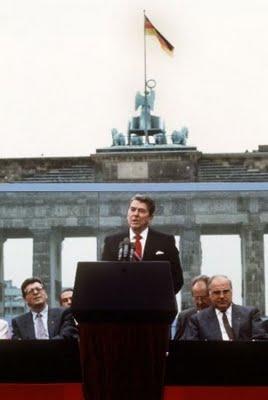
IN NOVEMBER 1989, weeks -days even- after the Berlin Wall had fallen, my brother went on a week long excursion to Berlin with his history class. Senior year, 18 years old, traveling from Holland to Berlin, Germany, where it was all happening. The Germans, who never partied, never did anything spontaneous, who always maintained law and order, suddenly found themselves throwing the party of the decade, without having organized as much as a bar and a band.
People took to the streets, bringing beer and champagne, laughed, talked, hugged total strangers. Flower Power in Germany, all in the middle of a particularly rugged autumn. So, chaos, party, action and a fun demolition to boot. And while I had to watch it on television with my parents, my brother was actually there. Not sure if I've ever been more jealous about something.
I also remember President Reagan, giving a speech some two years earlier in (then still) West-Berlin, in front of the Brandenburger Tor, saying "Mr. Gorbachev, tear down this wall!" It's probably one of the most defining one liners of Reagan's Presidency. Standing there all brave and determined (well, in a senior citizen kind of way), challenging that most reasonable of all Soviet leaders. I never thought much of it back then, but lately I've started seeing it in a different light.
Of course it was an actor's line, and one like no other President could have delivered the way actor Ronald could. In the days leading up to the speech, aides advised Reagan to scrap it from the speech, because it might jeopardize his - otherwise promising- relationship with Mr. Gorbachev. But how could he have ever even considered it? It would be the line of his life, spoken right there in front of the Berlin Wall, that San Andreas fault of world politics.
And so he did.
Did saying it really change the world? Did it really 'tear down The Wall'? It's tempting to think so, and many still do. How it emboldened the East-German people to fiercer resistance and louder voices of dissent. One argument sustaining this, is the apparent hope of today's Iranian protesters, to receive the same sort of support from President Obama in their struggle for freedom. At recent anti-government rallies, many of them could be heard chanting: "Obama, Obama — either you’re with them or you’re with us". They realize they can't expect much more than verbal support, but it would still be more than they've gotten so far.
To be sure, after you unravel all the bullshit, there really isn't much difference between Communism and Islamism. Both ideologies use supposedly supreme principles, leaders and rituals to suppress people into obedience, and worse.
And though I know it's early days, I can't resist thinking about the one liner that will define President Obama's Presidency. Will it be "Yes we can!" (but we never did). Or something more like: "Mr Ahmadinejad, tear down this dictatorship!"
My brother did bring me back something from his school trip to Berlin in November 1989. It was a small piece from That Wall. I still have it.
21 September 2009
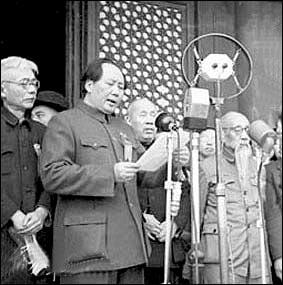
IN A FEW DAYS, it will be 60 years since the Communist Party of China (CPC), led by Mao Zedong, established the People's Republic of China. After a civil war that had lasted 22 years and was only interrupted so both sides could fight as allies in another war (against Japan, from 1937-1945) -talk about a devil's pact- the CPC came out as victor.
On October 1, 1949, in a grand ceremony at Tiananmen Square, witnessed by 300,000 people, chairman Mao solemnly proclaimed the People's Republic of China. (reading from a Letter sized crib, so as not to forget to mention all the people without whom the People's Republic would not have been possible)
But just as many modern day Republicans, Mao struggled with the discrepancies between Utopia and Reality. His Utopia was the communist society, purged of all "liberal bourgeois elements" (meaning capitalism). But he also wanted a modern society, wealthy, powerful and internationally respected. This, of course, is remarkably similar to Republicans who want health care companies to provide better, cheaper care for everybody, without being regulated at all, just out of the goodness of their capitalist hearts. (meaning where the lion lies with the lamb and all that)
Like so many dictators before him, Mao meant well but could never quite accept that Reality always has some demands of its own.
Take the Great Leap Forward, which he launched in 1958. The idea behind it -rapidly transforming the country from an agrarian society to a modern, industrialized nation- was a noble one. But the program proved to be too big a success for its own good, as hinted at by its aka name, Great Chinese Famine ( and the fact that 36 million Chinese starved to death). Just as the 47 million uninsured Americans are -in some ways- a monument to the success of capitalism. Because there is a reason why those people are uninsured or left untreated, namely their cost would outweigh the yield. They might be sick already, have a higher risk of becoming sick, or can't afford insurance. To insure such people would be a losing proposition. (and that's not what this country is build on)
A few years after the disaster of the Great Leap, Mao started the Cultural Revolution (1966-1976). Trying to uproot the evil tree of Capitalism once and for all through post-revolutionary class struggle. Much like there are those in today's world who will do anything to put that capitalist tree back on its exact same spot again, even though the storm of 2008 showed some of its roots have long been dead.
To some, a good old fashioned ideology is worth millions. Stalin's Soviet Union, Pol Pot's Cambodia, Mao's China. Millions died or were ousted from their jobs, humiliated, re-educated and imprisoned. But under Mao's successor, Deng Xiaoping, China quickly learned the key lesson to survival and success: always remain flexible and adaptable, instead of becoming dogmatic and rigid.
Amazingly enough (considering the US was already the richest country in the world when the Chinese were still painting their Little Red Book) the challenges the US and China face in the coming decade(s) will be largely the same: getting the people better health care, education, environmental protection and other social services. Seems the US needs Barack Obama to be its own, home grown Deng Xiaoping, teaching it to become flexible again, and adapt to the challenges of today and tomorrow.
21 May 2009
As the famous quote from the movie Fight Club goes: "On a long enough time line, everyone's survival rate drops to zero." True though this may be (how can we ever know for sure?), some people have beaten remarkable odds; twice. First, by utterly defeating -and subsequently annihilating by proxy- those other 150 million sperm cells. Second, by staying alive when people around them died like flies.
In 1869 the last surviving veteran of the American Revolutionary War, Daniel F. Bakeman, blew out his last proverbial candle. There were 110 proverbial candles on his proverbial cake. Five earlier ones had been blown out during that other epic struggle on America's own soil: the Civil War of 1861-1865.
The last surviving American Civil War veteran, Albert Woolson, died well after WO II, in 1956, aged 106. Opened his eyes well before the invention of planes, cars and Edison's light bulb, and closed them while big fin cars where all the rage, children watched Howdy Doody and teenagers went crazy over Elvis and his hit Heartbreak Hotel.
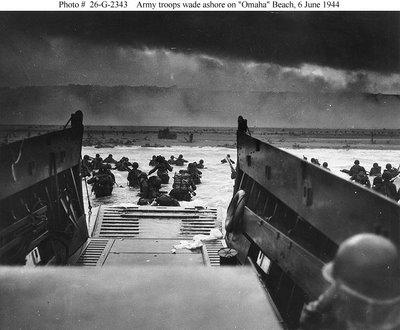
As of today, there are still 6 World War I veterans alive. All 6 of them are veterans of the allied forces. (Survivor: Total Annihilation editon, Allies vs. Central Powers: 6-0). The oldest is 112-year-old Henry Allingham (also Europe's oldest man), born on June 6, 1896. On the day he celebrated his 48th birthday, the Allies landed on Normandy. (Bet they made some jokes about how kind it was of Eisenhower to let the invasion start on his birthday). On November 11th 2008, he was present at the annual memorial service in London.
There still are over 2 million World War II veterans alive today. (They die at a rate of about 900 a day)
One of those 2 million is Rochus Misch (1917 - ), the last survivor of the Fuhrerbunker. He worked as a courier, telephone operator and bodyguard for Adolf Hitler, right until he committed suicide on may 2nd 1945. The last one alive who actually knew the man. Infamous by association. Soon after the war ended, the Russians captured Misch. When they released him in 1954, he moved into a house in Berlin, 2 miles from the remains of the Fuhrerbunker. (Civil War veteran Albert Woolson was still alive then)
He still lives there today and regularly receives visitors wanting to interview him (one of the more recent ones being Christopher McQuarrie, writer of the screenplay Valkyrie).
The other day I read an article containing several quotes by World War I veterans. Many of them urged "not to forget", "to remember", so that it "wasn't all for nothing". But we will forget. In fact, many of us already have, if we ever learned about it at all. In a recent poll among high school students, more than half of them couldn't answer the question when the second world war took place, let alone the Great War.
And soon, very soon after the last veterans are gone, the blood of historical compassion will run cold, leaving nothing but fossilised stories and statistics. Some call this lack of collective long term memory our greatest weakness, others our greatest strength. Perhaps some lessons are best learned when repeated. I don't know.
But I will try to remember Henry Allingham's birthday this year, on June 6.
22 April 2009

Here's one item that could have made the Dutch news 66 years ago:
"Man found dead this morning in the village of Staphorst. He was shot in the head 7 times. The police has reason to believe it is the work of subversive elements wanting to overthrow the government. Chief of police Oberst Rattenhauer has said the perpetrator -or perpetrators- will be caught and dealt with swiftly and harshly. Germany is winning on all fronts! Sieg Heil! "
Never did though.
I still keep track of what's going on in Holland, even though it's been three years since I left for Paris. I'm not nearly as informed as I used to be -my news is mostly bits and pieces nowadays- but still, it's my country.
This morning, I read a bizarre story about a man who was in the Dutch underground during the war (WW II). I used to love stories about the war when I was a boy. Children's books, movies and series, they all made living in occupied Holland seem mighty exciting. (the kind of luxurious excitement exclusively for boys growing up during peace time) On my way to piano lessons I used to cross an old bridge where, in 1944, the Dutch underground had attacked the car of SS General Rauter, attempting to kill him. He was not in the car though. As a reprisal, the Germans deported all 661men and boys from nearby village Putten. 121 returned. Crossing that bridge always gave me a thrill.
For the first time, this man spoke about an assassination he and other members of his group had carried out 66 years ago, in 1943. Soon after the killing they had realized their victim was probably not a nazi collaborator. But the deed was done, so they buried him and kept silent about it even after the war was over. The disappearance remained a mystery for the victim's family and other villagers. Until yesterday.
Remorse can live a long life in good souls, as this former member of the resistance has experienced. Wanting to come clean he now finally broke his silence, telling the story to the victim's surviving family members and explaining to the authorities where to find the body.
"He was shot in the head 7 times. And I can still hear him saying, after already being shot in the head four times" (!): "Waarom schieten jullie me dood?" Why are you killing me? (They probably used a crappy British gun though. Had they used a German Luger, one shot would have been enough).