
Politics
2 November 2009
THE DAY AFTER TOMORROW, it will be exactly 1 year since Democracy celebrated one of its more promising victories, when the United States elected as its President a black man who campaigned on positive change. This year, so it seems, democracy hardly has reason to party at all (if not mourn over lost opportunities). Altough, much of it may prove to be in the eye of the beholder, changing perspective over time, with history soldiering on.
In June, for the first time since -well, ever- democracy started openly shaking its tail in Iran. Though elections are held regularly there, the Islamist powers that be always make sure nothing too distressing ever results from them. Like you have the (infamous) communist democratic model -offering the choice between one candidate- there is also the Islamist democratic model -offer the choice between several candidates who are exactly the same.
But this year, something odd happened, when a previously normal (that is: islamist, highly conservative, defender of the Great Revolution and all that) kind of candidate, gained momentum as the preferred candidate of many of the young -slightly more modern- Iranians, because rumor had it that Mr.Mousavi was not wholeheartedly against women participating in public life, seemed to have a less destructive eye on the development of secular education and did not like adulterous women being stoned to death. Suddenly, Mr.Mousavi was crowned -both inside and outside the country- as the Obama of the Middle East, a hero of change.
When incumbent President Mahmoud Ahmadinejad still won the election, widespread fraud was suspected and uncovered, whereupon the Islamic Republic of Iran showed its true face, clubbed some of the more vigorous protesters to death and imprisoned dozens of others. 0-1 for Democracy.
Another novice to freedom of choice, Afghanistan, also held its elections in the Summer of 2009. Or held, 'started' might be a more suitable description, since the process took until today to fully unfold, and then only because the last remaining opponent withdrew from the race.
What happened? Well, a couple of weeks after the first round, Hamid Karzai was elected winner of the whole thing, because he had so many votes a second round wasn't even necessary. Turned out though that the elections had been riddled with fraud ( a little disappointing after you've defied Taliban suicide attacks and thumbcutting reprisals to cast your vote in the first place) and a second round was necessary after all.
But today, opponent Abdullah Abdullah withdrew, stating that not enough guarantees had been made to prevent the same widespread fraud in the second round. 0-2 for Democracy.
And last but so not least, the E.U. Presidency. In less than two weeks -barring extremely anti-climactic events- the European Union will chose its first permanent chairman of the European Counsel, an office popularly known as that of 'European President.' Candidates range from former U.K Prime Minister Tony Blair to incumbent Dutch Prime Minister Jan-Peter Balkenende.
And to make it absolutely, 100 percent certain no voter fraud is even possible with the election of the European President, no election will be held at all. That's right, the Lisbon Treaty on which the European Presidency is based, in its effort to make the EU less complicated and more democratic, has -in its infinite wisdom- provided for the creation of a European Leader who will have ZERO electoral mandate. Instead, the 27 leaders of the European Union will make the choice for the people.
I'd say that's 0-3 for Democracy.
3 September 2009
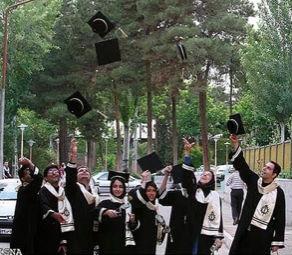
Summer break is over, and while Western countries are preparing for widespread outbreaks of the Mexican flu in schools and universities, the Iranian regime seems to be preparing to combat an even more elusive virus, believed to be going around Iran's universities: independent thinking.
Last Sunday, Ayatollah Khamenei said that the study of social sciences "promotes doubts and uncertainty", which is Islam fundamentalist code for saying "they're bad, m'kay?". (Or, as master Yoda could have told Luke Skywalker: 'Thinking leads to doubt, doubt leads to moderation, moderation leads to reform, reform leads to evil.')
Khamenei went on to say that "Instructing those sciences leads to the loss of belief in godly and Islamic knowledge." Meanwhile, President Mahmoud Ahmadinejad has made similar remarks in recent speeches, suggesting that the study of secular ideas has made universities hotbeds for the political unrest that has swept through Iran since the presidential elections last June.
When a government starts fearing its universities, the writing's on the wall. Inevitably, such a government is doomed, since the guys & gals in the universities are destined to rule the country in the foreseeable future. The only way to effectively stop this from happening is to kill them. Most regimes go for door number 2 though, a wishy-washy crack down on some professors and student leaders, hoping to scare the rest into submission.
Door number 2 is exactly what Iranian universities are fearing at the moment, particularly the political and social sciences departments. An understandable fear too, since the religious leader of their highly religious country is calling on "ardent defenders of Islam" to "review" universities' social sciences because they "promote secularism" (which is Islam fundamentalist code for "If it wasn't so damn hot in this country, we'd organize ourselves a good ol' fashioned social sciences book burning”).
Granted, writing off all social sciences would be a good first step towards returning Iran to the way it was before all those foreign ideas came pouring in, back to that comfy cozy 6th century A.D. No evil economics, history, linguistics, political science, psychology and sociology, just the Qur'an and nothing else (except of course for the Arab invaders, occupying the country). Obviously it would be hard to play a significant role in the world of today, but as long as the oil keeps flowing, why bother.
During the Islamic Golden Age, scholars, artists, poets, engineers and philosophers contributed to the growth and enlightenment of an Islamic culture that influenced societies all over the world. From the 7th till the 13th century -hundreds of years before the European Renaissance- Islamic scholars studied and incorporated knowledge from ancient civilizations such as the Roman, Mesopotamian, Greek and Chinese.
During that period, Islamic thought was open to ideas about freedom of speech, democracy, liberalism and even the occasional secularism. Makes you wonder though, if they couldn't keep ideas from foreign civilizations out back then -when they were transported on the back of a camel- how will they keep them out today -when they are transported on the back of a mouse (click).
What a difference with the Islam of today. How disappointing it must feel to some, that a religion once open to new ideas, spreading wisdom and enlightenment of its own, has become so rigid, angry and frightened. And how disappointing that a country that could turn this around, showing the world there was once a different Islam, an Islam of contemplation, openness and kindness, is instead moving in the opposite direction.
Or perhaps they are turning it around right now.
10 August 2009
Last year's presidential elections evolved around health care, the war in Iraq and the economy. Republicans wanted to keep government out of health care, in Iraq and out of the economy. In other words, the Iraqi people should be helped (whether they wanted to be or not) GoldMan Sachs, A.I.G and Morgan Stanley should also be helped, but US citizens should take care of themselves thank you very much.
Just before leaving office, President Bush (images of the kind old captain holding the wheel in the movie 'Titanic' come to mind) signed off on the Troubled Asset Relief Program (TARP). TARP handed out hundreds of billions of dollars to the big financial institutions -through the buying of assets nobody wanted- thus keeping the big boys from drowning. But Republicans on the Hill fiercely resisted tighter regulation of the financial sector, arguing "the market is best served without government interference".
Well, apparently the financial market now seems to think it's necessary to hand out tens of billions dollars of bonuses to its employees again. Goldman Sachs alone has already put aside as bonus money half of it's $5.2 billion profit for the first two quarters, which, if repeated for the next two quarters, comes to over $300,000 per employee (they must have the best paid janitors in the world).
The financial market also seems to think increased risk taking is the smart bet, since the government will have its back when things go sour anyway. So the same Goldman Sachs that received $10 billion in relief money has increased it's Value At Risk (VAR) considerably since January 2009.
Meanwhile, ordinary Americans operating without a cushy safety net, are trying to deal with their own VAR. Many have a monthly income worth less than Goldman Sachs CEO Lloyd C. Blankfein's cuff links, but they have their own bonus system going. As reported by the NY Times last week, sales of guns, ammo, chicks and garden seeds are up considerably, compared to last year. And even though it costs about $8 to raise a chicken and you can buy one for less than $4 in the supermarket, it still gives a sense of security. (you know, like having a couple of spare sets of those platinum cuff links you love so much).
The irony (or sadness, really) is that many of the people buying those guns, ammo and chickens are also the people against "big government".
They oppose tighter regulation of the financial sector, even though it will be their hard earned tax dollars bailing out the 'too big to fail' banks and insurance companies again, if they make the same mistakes again. (and why wouldn't they? What do they have to lose?).
They oppose increasing public funding for the public transportation system, even though they're the most frequent users.
They oppose increasing public funding for the public educational system, even though their children won't come anywhere near private schools.
They oppose stricter gun control laws, even though the US has a homicide rate more than 5 times higher than the UK and the Eurozone. (yes, the 2nd Amendment says 'A well regulated militia being necessary to the security of a free State, the right of the People to keep and bear arms shall not be infringed', but let's face it: most of us are not in a militia, nor are we living in a country unable to defend itself).
They oppose public health care, even though 47 million of them are uninsured and the rest have insurance from companies that never pay up. Can somebody please explain to these poor, dumb bastards that they're the ones who would actually benefit from a 'big government'? That it would mean better public transportation, safer bridges and fewer holes in the road, better public education, fewer homicides, better unemployment benefits and yes, universal public health coverage that would not financially ruin them whenever they break a leg?
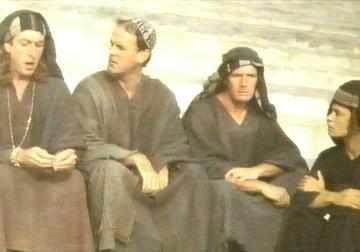
It's like that classic scene from Monty Python's Life of Brian: "But apart from the sanitation, the medicine, education, wine, public order, irrigation, roads, the fresh water system and public health, what have the Romans ever done for us?!'
'Brought peace.'
'Oh, peace, shut up!’
9 July 2009

IS 2009 GOING TO BE the summer of Uyghur and Iran?
Are the Muslims waking up to a revolutionary era of their own? Are they warming up to the ideas of certain inalienable rights, democracy and the rule of law? Hard to say. The revolutionary process knows several stages, and the Iranians only just completed the first one: Anger. The second stage -coming up with an alternative organization of the state- is much more difficult. Meanwhile, the Uyghur in Xinjiang autonomous region are still very much in stage one.
We've always been the restless kind. A revolution loving species, unlike sharks and crocodiles, who haven't changed their tricks in a gazillion years. In the past 500 years alone, we went from burning witches and infidels at the stake, to, well, ehmm, stoning them.
No no wait, I can save this.
Look, it's like this. You can't build an organized society without living together peacefully, and you can't live together peacefully without devising some set of rules everybody needs to adhere to. When humans started living together they didn't have any Locke, Montesquieu or Rousseau, all they had was imagination, so they came up with religion.
Religion gave them a body of rules and bounded them together, so they could live together peacefully, and build pyramids, temples and lighthouses. (and fight wars against other peaceful societies)
For thousands of years, the Haves used (or abused, depending on the view) religion to oppress the people. The king, pope, emperor, ayatollah, dalai Lama, grand wizard of Waziristan or whatever his name, was said to be handpicked by the allmighty and that was the end of it. Do as he (usually a he) says or burn at the stake. (or be stoned, boiled in hot oil, buried alive, eaten by giant lizards, you get the idea)
Then the Age of Enlightenment arrived and some people started writing about the rights of the individual, democracy and the rule of law. Their ideas had some early success in some distant colony on the other side of the world and before you could say 'United States of America' they started to catch on at home in Europe, too.
For 200 years the West wrestled with its democratic experiment. No to a king, yes to a king as long as he doesn't have any powers, nobility running parliament, elected officials running parliament, away with democracy let's all hail the dictator, away with dictators let's hail to the chief. We messed up terribly of course. Only in the last couple of decades are we starting to get it right.
Back to stoning.
The reason why (some) Muslims are still stoning gays, adulterers and infidels (although nowadays shooting and hanging is also allowed), is because their society is still bounded by religion, instead of being bounded by the rights of the individual, democracy and the rule of law.
Some right-wing Western politicians think there is reason for smirking about this, but when you look at the last 200 years of history both in the US and in Europe, there can be only one real conclusion: after systematically killing and/or enslaving millions of Indians, blacks, gays, gypsies, Jews and political adversaries, there's really nothing left for the West to smirk about when it comes to basic human rights.
Still, let's hope this really is the summer of Iran and Uighur. Let's hope it won't take the Iranians as long as it took the West to successfully claim those certain, unalienable rights. And should the Uighur win their independence, let's hope they won't lose another 30 years of freedom by putting the word 'Islamic' in front of the proud name of their new nation.
16 July 2009
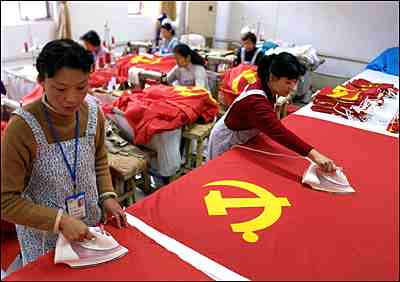
There is a new Rome on the horizon, fixing to dominate the world for centuries to come. And like all the other Romes before, it's hungry. Hungry for commodities like oil, steel and grain, hungry for cheap money to fuel its fast growing economy, hungry for respect.
A little over 30 years ago, Mao was still busy purging China from its 'imperialistic intellectuals' by means of the Cultural Revolution. But today, 33 years after his death, China has replaced the ideology of playing farm with that of playing monopoly. Turns out they have a nack for that too.
For the past 25 years, average annual GDP growth of China has been above 10%. in 2008, it was ranked the third largest economy in the world, with a GDP of $4.33 trillion (ranked first is the US, with a GDP of $14.26 trillion). An economic giant already, how will it affect the world if it keeps on growing at this pace?
Energy is key. Coal and steam power propelled the British Empire, oil is the golden locomotive (and cage) of the United States. But to become the world's largest economy China needs more. They're using coal and oil, and lots of it, but there simply isn't enough of it to keep going for more than a couple of decades. So China has turned to renewable energy.
This year, it has passed the US as the world's largest market for wind energy. It also has the largest solar panel manufacturing industry, and in the renewable energy market,Chinese-owned companies went from 25% domestic-market share four years ago, to 75% this year.
How come it's all going so fast? How is it possible that in a couple of years, pole positions and market shares in these strategic markets are lost by western countries and companies? Because the Chinese economy is not nearly as laissez-faire as the US economy.
China has found a loophole in the failing ideology of communism: cut out everything that has anything to do with communism, but keep the highly centralized one party state. So when the Communist Party of China (CCP) wants to build 6 wind farms with a capacity of 10,000 to 20,000 megawatts apiece, they make it happen. No congressional commissions, no haggling with individual Senators who will only go along if they get something extra for their own state. None of that.
Sometimes foreign companies are allowed to bid on government contracts, but of course they never actually win. Just like Japan and South Korea shielded their car market from Detroit automakers, so does China shield its renewable energy market from European and American wind turbine and solar panel producers.
There are several ways to get respect. You could kick the living shit out of everybody -the classical Roman way- you could pick on decidedly weaker opponents and demand respect from them -the British Empire way- or you could give everybody easy money and hope they'll use it to buy all the stuff you're producing -the American way.
Within 25 years, we'll get to know the Chinese way.
27 July 2009

On Oct. 23, 2001, less than 6 weeks after the Sept. 11 attacks, the US Justice Department wrote a memorandum justifying the use of the military on domestic soil. The memorandum was already declassified last March, but only a couple of days ago it became known that in 2002, top Bush administration officials actually considered using this document to justify the deployment of American troops on US soil.
Notably former Vice President Dick Cheney pushed for using the military to arrest a group of men in Lackawanna, near Buffalo, who were suspected of plotting with Al Qaeda. His chief opponent was Condoleezza Rice, then national security adviser. Reason for the debate was concerns about not having enough evidence to arrest and successfully prosecute the Lackawanna six.
Mr. Cheney argued that less evidence would be needed to declare them enemy combatants, in which case they could be send to military prison. Also, this course of action wouldn't have to be limited to the Lackawanna six. (meaning it could also be applied to you) Everybody suspected of being part of a terrorist group would be stripped of their civil rights by designating them enemy combatants. Not innocent until proven guilty, no lawyer, no public trial.
In the summer of 2005, Mr Cheney told Republican Senators that President Bush would veto the annual defense spending bill if it contained language prohibiting the use of cruel, inhuman and degrading treatment by any U.S. personnel.
In the fall of 2005, Mr. Cheney proposed that Congress legally authorize "enhanced interrogation methods" (aka torture). However, Congress did not, as this would violate some of the most basic human rights. (hurray for Congress)
In June 2009, Cheney (now way past deserving the title Mr.) admitted "enhanced interrogation methods" had been used anyway.
So, in Cheney's United States, the government should be able to use the military to round up citizens suspected of membership of a terrorist organization, ship them to a military prison -foreign or domestic- strip them of their legal rights, deny them trial and torture them for information.
Exactly how would this differ from an Afghanistan run by The Taliban, an Iran run by Mahmoud Ahmadinejad, an Iraq ran by Saddam Hussein, even a Germany run by Adolf Hitler? On 21 May 2009, Cheney, speaking at the American Enterprise Institute, said: "no moral value held dear by the American people obliges public servants ever to sacrifice innocent lives to spare a captured terrorist from unpleasant things."
If that really is the case, what then separates us from them?
Just take a moment and imagine what the world might look like today if President Bush had died in office.
How close to oppression we still are, after centuries of freedom.
11 June 2009
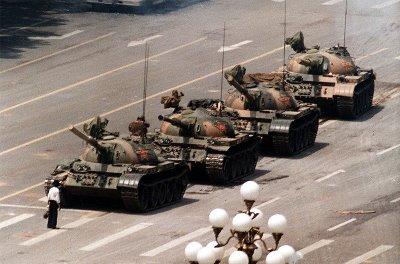
REVOLUTIONS MAY BE inspired by philosophers, they are started by the commoners. By the ones who've got nothing to lose and everything to gain; laid off factory workers, students without career prospects, soldiers fighting an endless war they don't understand.
The only time people really stand up to their leaders, demanding change, reform and rolling heads, is when they're completely out of options. The French people didn't storm the Bastille because they wanted to reform their government into a democratic republic upholding the rule of law, they stormed it because they didn't have any more bread left (hearing of this, Marie Antoinette famously advised them to eat cookies instead)
On June 4th 1989, Liu Suli stood in front of a rolling tank at Beijing's Tiananmen square, armed with nothing but a plastic bag and a determined mind. Trying to circumvent Liu, the tank moved, but Liu moved with it, maintaining his position. The tank moved again, and Liu moved again.
That day, Liu won the battle, but lost the war. The protesters -demanding political reform- were crushed by the military, killing hundreds (some say thousands). Liu Suli himself was imprisoned but survived. Today, he's 49 years old and has a cafe / bookstore in Beijing, close to Peking University.
Here's what the ruling Chinese Communist Party (CCP) has learned since that day: People don't give a shit about democracy. They don't give a shit about political reform and they don't give a shit about civil liberties. People care about stability, jobs, security, cars, cell phones and sex.
Therefore, there has been little political reform in China since 1989, but a lot of economic reform. The CCP is still all powerful, but the most important principle of communism -all available goods and resources are shared by everybody- has been replaced by the most important principle of capitalism: the right to individual ownership. As a result, the country has thrived economically, rewarding entrepreneurship, hard work and creativity.
A couple of weeks ago students at Peking University were asked about their thoughts on the 20th anniversary of'Tiananmen Square'. Most of them only had a vague notion of it, or had never heard of it at all. After talking about it a bit, they agreed political reforms in China were necessary, but that reform would eventually happen by itself and no protests were necessary. In reality, they were much more occupied by the financial crisis and the (current) problem of getting a good job after graduation.
But like NASA, the Chinese government doesn't take any risks. So, last week, it took every precaution to make sure nobody and nothing in China commemorated the 20th anniversary of the student protests (/killings). Blocking thousands of websites, including Twitter, Flickr, Windows Live and Youtube, they aimed to keep history where it already was: in the past.
And while the students are busy caring about getting a good job, the Chinese government is tightening its grip on their internet access and freedom of speech. This week, it issued a directive requiring all personal computers to be equipped with a new software program called 'Green Dam'. This program will enable the government to block all manner of content, monitor individual internet usage and collect personal information. In essence, it will create a Brave New World.
Companies like Dell, Lenovo and Hewlett-Packard are still 'studying' the new rules, declining to comment. In the end they will of course do what powerful Yellow-bellies like Yahoo, Google and Microsoft did before them: comply. (after all, 'Resistance is futile'). At the end of the day, it's always about the all mighty Renminbi.
Maybe we should hope the next financial crisis is worse.
16 June 2009
THERE ARE TWO KINDS of fake democracies:
1) the no-choice democracy
2) the all-you-can-cheat democracy
The no-choice democracy is democratic in every way, except when it comes to letting the people decide. They get ample opportunity to vote, polling stations have generous opening hours and scores of soldiers make sure the streets are calm. But there's only one option on the ballot, and it always supports the powers that be. Examples are the former Deutsche Demokratische Republik (DDR), the Democratic People's Republic of North Korea and the People's Republic of China (indeed, what's in a name).
In a no-choice democracy, the ruling party generally gets 99.9% of the vote. Results like these are meant to prove to the people they all think extremely alike (which is why there's also no need for different types of cars, clothes and shoes; or colors, for that matter) and they are all very much in agreement about the excellent job the glorious leader is doing.
The all-you-can-cheat democracy does let the people decide for themselves, but subsequently manipulates the outcome. Opposition leaders who become too popular are usually jailed or worse, media mostly cover the ruling party, and military and police forces are never far away, ready to 'keep the peace'. Examples are the Republic of Zimbabwe, Russia and -as of last weekend- the Islamic Republic of Iran.
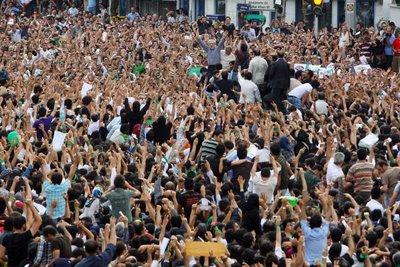
Last saturday, the closest electoral race Iran has ever seen ended with a landslide victory for President Mahmoud Ahmadinejad. According to the Interior Ministry, Mr Ahmadinejad got 62% of the vote, while Mir Hussein Moussavi, his most important opponent, got 34%. This, while most polls before election day showed a very tight race, with Mr. Moussavi having the upper hand.
Following the elections, several opposition leaders were arrested, opposition websites were shut down, text messages were cut off, universities were closed and a huge police force was called in to disperse the public. If it was a South Park episode, this would be the moment where everybody cries "shenanigans!'". Instead, angry young Iranians are calling it a coup d'état.
Of course claiming 62% of the vote was insanely stupid. All the pre-election polls showed a tight race. Not to mention the packed streets of Tehran, showing powerfull forces at work in the hearts and minds of Iran's young men and women. Claiming a landslide victory under those conditions is like an office worker stealing his whole cubicle, instead of just a couple of pens.
So why did he do it? Why claim 62% in all regions (including Moussavi's home town) instead of an overall 52%? Throw in a couple of losses in regions besides Tehran and you're almost certainly homefree. Very tight race, very tight result, but in the end the President won. Don't think that would have drawn a million protesters in the streets of Tehran.
But winning wasn't enough anymore. Ahmadinejad (and the conservative elite behind him) wanted to crush what was starting to become a movement of change (and to a conservative, change, any change, is bad). He needed a landslide victory to wipe out any hope, any belief, any idea that change was possible. Like it had never even been there, that even the mere idea of hope had never been more than a phantom, a mirage. Mr. Moussavi called the election result an act of official 'wizardry' , and that was exactly what the ruling party had attempted to achieve.
Sadly for all the dictators out there, it doesn't work that way. You can't kill an idea. Can you beat people into submission? Yes. Can you kill hundreds of thousands of your own people? Yes. But you can't make them agree with you. You can't make them love you.
No matter what he does next, Mahmoud Ahmadinejad has lost his legitimacy as President. And if Ayatollah Khamenei keeps supporting him, he's in danger of losing his own legitmacy. Spontaneous, popular movements are a funny thing (some would say dangerous). Like a wild river, they can turn ugly and topple the raft of power in the blink of an eye. Then, suddenly, it's not just about replacing the current bearded guy for a more benign version, but about a much farther reaching revolution, in this case aimed at undoing the shackles of the previous one.
How will it end?
Like always, the outcome is up to the people. It's all about how much they really want it.
22 June 2009

MAYBE IRAN'S SUPREME LEADER, Ayatollah Khamenei, is right. Maybe there was no voter fraud, no election rigging of any kind. Maybe President Mahmoud Ahmadinejad really did get 62% of the vote. Maybe the millions that have marched through the streets of Iran are wrong. Seriously, they could be. But it's still no excuse.
It's still no excuse to forbid peaceful demonstrations, to sanction police and para military violence, to block communications, to arrest reporters and opposition leaders. To kill.
Every revolutionary is an ideologist. He firmly believes, knows, he's on the right side of morality. And because his vision of society is so very obviously the right one, no citizen needs protection against it. Before the arrival of Joseph Stalin, who in their right mind could think Russians needed to be protected against the communist State of Lenin? Before the arrival of the Reign of Terror, who in their right mind could think the French needed protection against their own Revolution? Before the arrival of Dick Cheney, who in their right mind could think Americans needed to be protected against being tortured by their own government?
All societies are based on a social contract between the state and the people. The state is given authority to rule the people, who in return get stability and protection from and against the state. The state should never be run by people, but by the rule of law. Governments handling the affairs of the State have to abide by that law.
We tend to forget democracy is not the cake, only the icing. It's very nice to be able to go into a voting booth every four years or so, but the cake is made with those 'certain inalienable rights' that create free citizens and protect them against their most likely enemy: the State itself. This is why the Iranian revolution of 1979 (and so many other revolutions during the past 50 years) has failed; it hasn't given the people any absolute rights, protecting them against the state.
And now it's too late.
The social contract between the people of Iran and the State of Iran has been broken. Peaceful protest is met with state sanctioned violence, and if there is one thing the elections have proven (once again) it's that Iran's true leader is not a President chosen by the people. (So much for the word 'republic' in the Islamic Republic of Iran)
The people in the West have had to fight in the same struggle for power. Against tyranny, dictatorship, communism, fascism, religious fanaticism. Some of these fights lasted for years, decades even. Millions were lost. Eventually the people won, for the most part at least. But lest they remain vigilant they might still lose, because no people is ever absolutely safe against the virus of absolute power.
14 May 2009

Ask people to look 200 years into the future and they will all describe a world very different from today.
Many will talk of great achievements, since we've always been a very optimistic species. (unlike chimpanzees, who always seem to have something to bitch about). Space exploration and colonization -no exploring without some good ol' fashion colonizing of course- flying cars, driverless trains moving at Mach 2, cheap green resources for everybody, the end of world hunger. Just to name a few of the more modest goals.
Of course there are also those with a highly developed dark side. They'll be talking nuclear holocaust, CALE © (Climate Apocalyptic Level Event), killer viruses, killer bees, black holes pouring out of man made particle colliders, you name it. They resist giving in to the happiness that's luring them towards the lighter side of life, convinced it won't last much longer and afraid to jinx it.
And then there are the idealists. Unhappy with the world of today (like the chimpanzees), they hope, support or fight for a better world. Of course it's never about anything small. You won't find any idealists fighting for something others are willing to give. It's always something big, like women's voting rights, gay marriage, removing some dictator from power, bringing some dictator to power, free all the animals, making the world safe for Islam.
Idealism today is still shrouded in the same veil of friendly naivety it acquired in the 1960's. Flower power, free love, world peace, that sort of thing. But idealism as a concept is amoral. There is no universal right or wrong that all idealists agree on. They all strive for their own paradise.
Sadly, one man's paradise is another man's hell.
Starting a couple of weeks ago, The Taliban in Afghanistan have taken to using whole platoons of suicide bombers instead of individual bombers. No defense cutbacks for them. (no casualty cutbacks either). A couple of bombers storm the gates of some building and blow themselves up. Others follow and blow themselves up at the entrance of the building. The rest enter the building and blow themselves up at will.
An intercepted audio tape of a briefing before one such attacks might sound like this:
'So let's look at the maquette of the building. Ok, Mustafa and Mohammed, you will blow yourselves up here and....here, all right? Praised be Allah, glory to His name, please receive these two martyrs and bestow upon them 70 fair haired virgins.'
'Yes sir, thank you sir!'
'Next we storm the square. Well, not me of course; you. But I wish I could be with you. Achmed 1 and Achmed 2, you will blow up...here and here. Praised be Allah, glory to His name, please receive these two martyrs etc.'
'Yes sir, thank you sir!'
'Finally the rest of you..... Ali, Aamir... Abbud, Najid, Parvez... Sarosh, you will enter the building and blow yourselves up at will. Praised be Allah, glory... and all that.'
'Yes sir, thank you sir!'
'Good. Well then I guess this is goodbye. Don't forget to save me some virgins, since I will probably not die a martyr.'
'Yes sir thank you sir!'
'No, no, thank you!'
At some point in the future, Islamism, like certain ism's before them, will be drained of most of its followers by the one ism that has proved to be unbeatable: individualism. Muslims will finally demand the separation of church and state, so as to protect their own religious freedoms against governments and judges. Islamic women will demand equality and Islamic homosexuals will fight for their rights.
I wonder if 200 years is enough though.
28 May 2009

When Donald Duck is asked to play for Duckburg in an epic baseball match against Goosetown, he asks inventer Gyro Gearloose to invent a bat that cannot miss. There's a lot riding on the game, because Duckburg always loses from Goosetown and this time they desperately want to win. So Gyro, also a citizen of Duckburg and the team's star pitcher, helps them out, making 'bats-that-never-miss'.
But then Goosetown supporters discover Gyro was actually born in Goosetown and force him to come out for their team, threatening to ruffle his feathers if they lose. What would you do if you're both a star pitcher and an inventer, facing opponents with bats that never miss? Exactly, you invent balls that can't be hit.
But what happens when a bat that can't miss, meets a ball that can't be hit?
Such is the story of Iran, Israel and their upcoming epic A-Bomb match. Forget the UN, forget the EU (if you were even thinking about them in the first place) and forget the US. This is one match that cannot be fixed.
These are the three fundamental problems preventing a solution:
1) Muslims hate Jews. That, and the name of Allah, are probably the only things Muslims of all denominations wholeheartedly agree on.
2) As a people, the Jews are fucked for life. On some psychological level they're still collectively fearing extermination, they're still fighting to protect themselves against great evil. Like a grown man who was abused by his parents as a child, Israel evolves around preventing something that already happened.
3) In many ways, both Muslims and Jews are still living in the 1940's, when battered Jews where battering Palestinians, securing a country of their own; where they would be safe.
So the Muslims won't stop untill the Jews are gone, and the Jews will never leave unless they're all dead. Iranian President Mahmoud Ahmadinejad has said he wants to wipe Isreal off the map and/or in the sea (or somewhere in the sky, as long as it's far far away). He has also said that 'The nuclear issue is over', meaning that whatever talks will take place with the US (and the rest of the world) Iran will never stop it's nuclear program.
And while Foxnews is entertaining the masses with the results of deepthroat level research on First Family dog Bo's pooping habits, every real journalist and politician realises Ahmadinejad is right: Iran's nuclear issue is over when the Iranians say it is. After all, what can the world do? Sanctions aren't going to stop it from developing The Bomb. Look at North Korea, a country with a GDP the size of Cyprus, more than ten times smaller than Iran. Sanctions, promises, six party talks, a population that can hardly feed itself and yet they recently conducted a second nuclear underground test.
Iran will eventually develop The Bomb and the technology to mount it on a missile. Together with accurate long range missile technology (recently aquired) this would give it the power to launch nuclear missiles. There really is only one way to stop Iran from developing the bomb.
Force.
But the UN will never sanction this and the US will never go at it alone, not again. So perhaps the world will have to swallow the inclusion of Iran in the club of nuclear powers? The world, maybe. The israelis, never.
No matter what Mr. Obama promises Mr. Netanyahu, if it's stopping short of using force to prevent Iran from developing a nuclear weapon, Israel will not accept it as a solution. They feel they simply cannot take the risk.
I think Iran has the right to develop a nuclear weapon. But I can also understand Israel's view, that it must take all necessary steps to prevent it. So what does happen when a bat that can't miss, meets a ball that can't be hit?
All bets are off.