
Economics
12 October 2009

A couple of months ago, an old and dusty word turned young and hip in a matter of days. Traditionally, this word would mostly conjure up images of coupon shopping, of wives who save pennies in jars and of putting on an extra sweater because the house is so cold. In short, the kind of word you wouldn't want to be caught dead with.
But after Lehman Brothers fell and the world entered The Great Recession, frugal became the new star of the dictionary (because we all had to look it up first). Suddenly, everything had to be cheap; food, clothes, gifts, and most of all: behavior. For the first time since never it was cool to be cheap.
Whether you lived in Southwest Detroit and simply had no money to buy new sneakers because you were laid of by GM (days before its directors flew to Washington in a private jet, begging for more money) or in Manhattan -not owning sneakers but still having to sell the villa in Tuscany- you could both look cool by wearing a pair of worn out adidas.
Should you have missed the start of the hip frugal party, don't bother, because it's already over. Within six months, frugal has gone from hero to zero and back again, and with it, a whole bunch of other things that seemed destined to be changed. The banks would be restructured, bonuses would go down, every American would (finally) be able to afford health care, Iran would be called to order and the world would go back to normal again. And when you hold a patch over one eye and squint the other, it might even look that way, if only for a moment.
But without wanting to sound discerning, to me, 2009 much more resembles 1919 than it does 1946. True, we just overcame a huge problem, preventing the complete meltdown of the financial world. Governments issued hundreds of billions of dollars of stimulus money, guaranteed to back banks and their toxic loans, and replaced the elitist G7 with the (slightly less elitist) G20. But just as defeating the Germans and founding the League of Nations wasn't good enough when it came to preventing the Second World War, the current half-assed measures aren't going to prevent a second, real, meltdown.
'Back in the day' (meaning about 4 months ago), when everybody was still being frugal, about the only thing Republicans and Democrats agreed upon, was that something needed to be done about those big banks, to prevent another systemic crisis. Meanwhile, those big banks themselves kept very, very quiet, after just having received hundreds of billions of dollars to shore up their balance sheets and honor their agreements.
But then the markets bottomed out, the banks put all those (taxpayer)billions to work to get in cheap, and suddenly they were making billions in profits again. Soon thereafter, they paid off their government debts and that was that. In all fairness, some European countries -notably France, Germany and the Netherlands- did make headway with capping bonus pay in the financial sector, but the banking system itself was left alone everywhere.
So what do we have to be afraid of? Last week, the Congressional Budget Office estimated that the U.S. budget deficit over the fiscal year 2009 (which ended at September 30) was a whopping $1.4 Trillion, which is 9.9 percent of the GDP, while the deficit for 2008 was $459 billion -which was already considered huge at the time. As of today (12 Oct 2009) the U.S. national Debt Clock stands at $11.9 trillion. (if you love numbers, be sure to watch the debt clock roll on).
Meanwhile, the dollar is weak and getting weaker (in part because of the growing debt) and even though a weak currency has its advantages when it comes to international trade, these advantages will be outweighed by their negative brothers quickly, when investors decide to abandon the dollar in favor of a more robust currency. In fact, one of the reasons the dollar has been losing value against the Euro so quickly (16% since March) is because investors are already turning elsewhere.
Of course, if needs be, the dollar will be propped up by the Fed and foreign central banks; for now. But for how long? And because banks have not been restructured, the Goldman Sachses and Morgan Stanley's of the financial world will continue to grow, doubling or tripling in size (compared to the fall of 2008) over the next 10 to 15 years.
And then? Will they be saved again, when it's '1939'? Or will the next crisis be even bigger and ever more incomprehensible?
24 September 2009
With the G20 gathering in Pittsburgh today, every man and dog is putting in his or her two cents on how to "get to those banks" (as one -less subtle- liberal radio host put it). How to "cap those bonuses" "eliminate the bonuses", or, my personal favorite, how to "claw back the bonuses" (note to self: idea for new super hero movie, 'The man with the silver claw' , steals from the banks, gives to the poor).
There has been so much attention for bankers and their outrageous bonuses that you'd have to be a 3rd week fetus not to have an opinion about it. (And to all those 4th week fetuses and up who have a dad in the banking business, now's the time to ask for a big allowance raise: 'but dad, you still got that big bonus last year and I'm afraid to tell my friends you're a banker.' triple AAA guarantee that it'll work)
Now I'm no friend of the banking industry -as my articles on banks and the bailout scheme show- but blaming bankers for being greedy is like blaming dolphins for eating fish. (yes, they look cute and it would be so jolly golly wonderful if they were vegetarians too, but they're not). The simple fact is that bankers -like most people- have always been greedy.
So when former French foreign minister and current special adviser to the UN secretary general on innovative financing, Philippe Douste-Blazy, writes in an op-ed in today's NYTimes that the banking industry "has a duty to give back" , it's immediately clear that while having a beautiful job title, Mr. Douste-Blazy is no economist (in fact, he's a cardiologist).
Mr. Douste-Blazy wants to tax the foreign currency market, arguing that banks won't even miss the money, just like the "small tax on airline tickets" -has- "without hurting the airline industry, raised about $700 million". Obviously Mr. Douste-Blazy thinks that those $700 million were actually paid by the airline industry itself, instead of being charged as extra fees to airline customers.(must be wonderful to live so far from the real world). And is he really serious with his 'it's not really stealing when the amount is really small' argument? If so, let's help the French hope he'll never become the head of the Trésor Public (Public treasury)
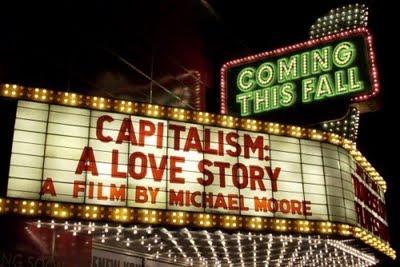
Also searching for culprits, in his new film Capitalism: A Love Story , Michael Moore goes one step further, blaming the entire system of capitalism. Moore: "Capitalism, in the last year, has proven that it's failed. All the basic tenets of what we've talked about the free market, about free enterprise and competition just completely fell apart." Sounds very plausible for a moment, but so does sex flavored ice cream (we all like sex, we all like ice cream, who wouldn't want this flavor?) until you stop and think it over for a moment.
Capitalism has neither failed nor changed, we have. We just can't handle those high peaks and steep canyons anymore, the years of double digit jobless rates and belly up. Maybe we expected capitalism to change with us and it didn't - and it never will. We'll just have to change it ourselves.
Let's hope world leaders will leave themselves some time for discussing the necessary changes in Pittsburgh (after clawing back those bonuses of course)
19 March 2009

WHEN THINKING OF THE MIRACLE of the Industrial Revolution, I think of great steam engines with ovens hotter than hell, stoked by the kind of men that would have today's soft ass guys for breakfast. I think of Grey-black smoke, vomiting out of the pipe of a shiny black locomotive in a continuous stream. I think of Chinese railroad workers dying by the bushes, paving the way for progress. I could go on for a couple of pages about this and in fact I'm getting enthusiastic just thinking about it, but hey, it's the fast age, no time for that.
Most people probably think of steam engines and locomotives when picturing the miracle of the Industrial Revolution. Still, the steam engine is not the real miracle. Because like so often, the real miracle might not look the part but it does play the part.
Standardization.
Simple, about as sexy as an accountant on a rainy Sunday, but steady as a rock. Thing is, you can have all the steam- and muscle power in the world, but if you can't use that power efficiently, it won't do you much good. Standardization enabled mass-production; millions of screws, nuts and bolts etc. of exactly the same shapes and sizes, accurate to the millimeter. This, in a nutshell, enabled faster, cheaper production and thus made products far more widely available, creating ever bigger markets.
Ironically, the magic word of our age is the opposite of standardization. Customization. While we left it to the Russians to further perfect the concept of standardization (who went at it with tireless vigor; well, the politburo that is, the people soon had enough of all having the same cars and apartments and sausages) we in the West concentrated on what people really wanted.
But the people are fickle. They are easily manipulated into coveting a new toy, partner or job. Possession makes them weary and jealousy obsessive. They're born tabula rasa ,often die tabula rasa, and in between they buy stuff. And therein lies the limit of what standardization can offer. People don't simply want a car. They want a special car, preferably one that is the envy of others. And after a couple of years they want a new car. Not because the old one is damaged, but because they're bored with it.
Enter the producers. They want to sell stuff. Their dilemma is as simple as it is devilish: if they produce high quality stuff people won't need new stuff. If they produce low quality stuff people will go elsewhere. So they have to continually come up with new stuff that makes the old stuff obsolete. Next they have to convince the people to buy the new stuff, which -luckily for them- isn't too difficult.
But these past few years the process of customization has expanded its borders into the realm of absurdism. We've seen the customized "pimped" cars, phones and T-shirts, but now people are starting to order customized Kleenex boxes and M&M's with their initials. During the good years, new shops, websites and restaurants sprung up like locus, catering to a very small but loyal customer base. Now that the good years are gone many of those businesses will probably go under and standardization will make a comeback. At least briefly; because everything standardized is cheap.
The good years will return of course, and internet powered customization will propel us to boldly buy what no man has bought before. But in the mean time, we should maybe ask some old Soviet producers for advice on how to build boring, cheap, indestructible stuff that can help us through the crisis.