
Politics
20 April 2009
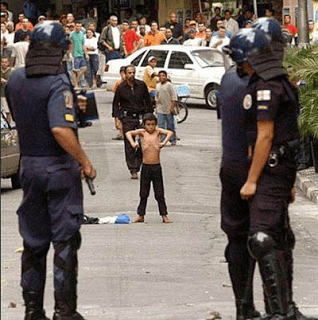
For all our talk about individual freedom, humans are very easily lured into following others. This has often hurt us more than it helped, but for many, following still beats thinking. Also, not following has frequently meant being beaten, or worse. (you're right, still does)
If I'd ask an Afghan woman how she can agree with a law that allows her to be raped by her own husband, she'll probably point to a text from some Great and Holy Imam, who has interpreted a text in the Holy Koran in such a way that it's saying raping is totally A-ok. (of course in reality she won't respond to me at all because I'm a man, and her husband is forbidden to talk to stinking infidels who do not want to rape their wives)
The problem has always been that we've allowed our world and beliefs to be shaped by a very small group of people, even until very recently. A couple of teachers, one or two clergymen, some journalists and government officials and that was about it. Really, until the internet arrived our world wasn't as big as we were sometimes led to believe.
The internet has made it far easier to tap into a world of collective knowledge. Consumer reviews about products, places and people, free news from sources around the world and millions of individuals publishing content about everything known to man.
But all of this is nothing compared to the potential of the new kid on the block, Twitter. A social networking site, but not like Facebook. A search engine, but not like Google. A news portal, but not like CNN. It's all these things, but in a new, very direct way, using a piece of cell phone technology -text messaging- that has been around for over a decade. (Goes to show that new things can sometimes be found in old warehouses)
Look beyond the cute little birdie and the inevitable daily wave of narcissistic messaging ('I've woken up and made myself some coffee') and what you have -what we have really- is the first town square able to house millions of people. And with that, we've regained the power to expose shenanigans of governments and companies.
Several multinationals have already been exposed these past few months. Most notable among them Facebook with its sneaky change of the terms of use (the 'we own your ass' clause) and Amazon with its deranking of books with explicit hetero- and homosexual written content; #Amazonfail.
Twitter allows for a very direct form of individual power, which closely resembles one of the world's first democracies, Athenian Democracy. The Athenians had a direct democracy, letting people vote on legislation themselves instead of electing representatives. During the past few decades many attempts -sincere or not- have been made to establish forms of direct decmocracy, but most of them failed. Is Twitter succeeding nonetheless? Who knows. In any case it looks like people can now wield real, direct power when answering that one question to rule them all: 'What are you doing?'
Last week Domino's pizza was also exposed, but it turned out that the (now ex-) employees who broadcasted a youtube vid of putting cheese up their noses before putting it on a pizza, where joking. In an official statement, Domnino's CEO -Pizza the Hud- said that trainees were in fact being taught not to put this particular brand of cheese up their noses.
Ok, so we the people aren't perfect either. At least we're part of them.
30 April 2009

A couple of months ago I read about the Uyghurs for the first time. Their story made such an impression on me, that when I wanted to tell a friend about it a week or so later, I could hardly remember any of the details.
Such is the tragedy of the Uyghurs and their struggle for freedom.
The Uyghurs are a central Asian people living in the Xinjiang Uyghur Autonomous Region. Or at least that's what China is calling it. Sometimes they also like to call it just Xinjiang, meaning New Frontier. Now I'm thinking Indians. Adventurous pioneers, wagon circles, bacon & beans, Remmington rifles. And the cavalry of course, General Custer's Last Stand, the trumpet charge. Millions of dead Indians. Not sure the Chinese know this though.
The story of the Uyghurs is very similar to that of the Tibetans, their geographical and politcal neighbor. Both ruled by China, both denied a country of their own, both suffering from oppression.
So why do we hear so little about the Uyghurs and so much about Tibet?
1) the Tibetans have the Dalai Lama. A man so sympathetic even Osama bin Laden has never threatened to kill him. Of course the Chinese would love to kill him if they could get away with it, but they don't count. (and they couldn't)
2) The Tibetans have Buddhism. Equally sympathetic. A religion yes, but filled to the brim with nice, relaxing thoughts and joyful colors. Hardly anybody knows or understands anything about it, but who cares? They have priests dressed in stylish red and yellow, what's there to understand?
3) Richard Gere. One of Hollywood's most famous actors, who knows the Dalai Lama personally and has been fighting for Tibet for years. Richard's heart is very big and I bet there's room for the Uyghurs too, if only he'd heard of them.
4) The name 'Tibet' . This really is every marketing department's wet dream. So short and spicy, just like Che (Guevara) in the famous Korda photograph, with the beard and baret (the one on all the merchandise, making Korda's family lots of money) The image is that walking around in a T-shirt with 'Free Tibet' on it almost makes you a freedom fighter. Or, for those that don't like to walk in t-shirts but do want to be almost freedom fighters, there are coffee cups, paintings, bathtowels etc. Try achieving that with 'Free the Xinjiang Uyghur Autonomous Region'. The Uyghur separatists themselves call it Uyghurstan or Eastern Turkestan, but with such a name they'll never get the support of that all powerful demographic: teens looking for a way to look cool.
5) The Tibetans came out of the closet first. We Westerners have only room for a certain amount of suffering, oppression, hunger, endangered species, war and all that. In this case, we already have a region in Central Asia oppressed by China. Sorry, if you snooze you lose.
Then again, nothing ever changed for the Tibetans either...
12 March 2009

IT'S THE WORLD'S LARGEST CYBER COMMUNITY and yet most of us know almost nothing about it:
China.
When I first discovered the internet I thought it would revolutionize people living under authoritarian regimes. Dictators would be exposed, people would educate each other at lightning speed, Muslim women would write for their rights and the world's oppressed would become free at last. (Yes I'm laughing too). Forgive me, it was the juice of youth.
I learned that, just as in the real world, there are ways of oppressing people in the cyber world. Algorithms that search and destroy all words, pictures, movies that are not 'suitable' 'appropriate' 'harmonious' and more of that crap. I remember loving this 'Sliders' episode where Quinn Mallory (The Hero) rescues the only existing copy of the US Bill of Rights, distributing it over the internet, so everybody knows about it. Not so long ago I saw the same episode again, only to find out that the magic realism of it all had been replaced by mere fantasy. (Some things are best left in the nineties)
But now there is new hope.
Today I read an article in the NY Times about a Chinese mythical creature called Cao Ni Ma, grass-mud horse. This horse is starting to get immensely popular in China. There are movies about him, a childrens song, pictures, and Chinese intellectuals are writing about the grass-mud horse's social importance.
Why is this so hopeful?
Because, like English words, Chinese words can also have a double meaning. And while 'grass-mud horse' can mean just that, it can also mean something insanely profane (well, in China that is). What, prey, can it mean as well then?
cao = "screw"
ni= "you, your
ma= "mother"
Now, the interesting thing is that the censoring algorithms searching for forbidden content, can't wipe out sites / blogs / pics etc that talk about this mythical mother loving horse that easily, because, as said, pronounced another way they're normal words.
And so, the mythical grass-mud horse is starting to be a way for people of opposing the authoritarian government, without it being able to do much about it. Like the small fish the early Christians drew in the sand, showing their true faith.
The freedom of the largest people on earth is in the making. Want to hear how that sounds? Check this out:
Song of the Gras-Mud Horse
Now please excuse me, I've got a Sliders episode to watch.